
If you’re just starting to think about cabinet hardware — the knobs, pulls, and handles that go on your cabinet doors and drawers — the finish category called champagne bronze is worth understanding before you spend a dollar. Champagne bronze is a warm, muted metallic tone that sits somewhere between polished brass (bright and yellow) and brushed nickel (cool silver). Think of it as a soft, golden-beige metallic with a satin, low-sheen surface. It’s having a real moment: Architectural Digest’s 2025 kitchen hardware trend coverage names warm metallic finishes — champagne bronze prominently among them — as the dominant direction for kitchens pairing white, cream, or greige cabinetry with warm-toned countertops. If that describes your project, this guide is built for you. We’ll compare the three main hardware silhouettes — cup pulls, bar pulls, and knobs — in this finish, address the real color-matching problem that keeps buyers returning orders, and give you a clear framework for making the decision before your project hits install day.
The Champagne Bronze Color Problem Is Real — And You Need to Solve It Before You Order
Here’s the most important thing to understand before placing any order: champagne bronze is not a standardized finish. It is a category, not a color code.
Aggregated owner reviews on Houzz for champagne bronze cabinet hardware reveal a consistent pattern. Buyers frequently flag that the finish they received reads more gold than expected, or cooler and greyer than the product photography suggested. That is not a quality defect — it is a category expectation gap. Some manufacturers lean warmer and more golden. Others produce a cooler, greyer champagne that reads almost like aged nickel in certain lighting. Both are legitimately sold as “champagne bronze.” Neither is wrong. But they will not match each other on your cabinet doors, and they may not match your faucet.
What this means for your buying process:
- Order a sample pack or single piece before committing to a full project quantity. Most reputable hardware brands selling 10-packs or 25-packs will also sell individual pulls.
- Hold the sample against your faucet, your light fixture, and your cabinet door — in your kitchen’s actual lighting, not a showroom or a product photo.
- Check the finish in both your overhead light and natural daylight. Warm-toned LEDs (2700K–3000K color temperature) will push champagne bronze toward gold. Cooler or more neutral light will reveal the bronze undertones.
This Old House, in its guide “How to Choose Cabinet Hardware,” specifically recommends matching hardware finish to existing plumbing fixtures as a first filter, then evaluating hardware in place before ordering in bulk. Don’t skip this step. The return logistics on a 25-pack of cup pulls are genuinely painful.
Cup Pulls vs. Bar Pulls vs. Knobs: What Each Silhouette Actually Does
These three hardware shapes are not interchangeable. Each has a functional and visual logic that matters once you’re laying out a kitchen with 30–50 hardware placements. The three subsections below map directly to three distinct market tiers — budget-appropriate, mid-range workhorse, and premium investment — because the silhouette you choose often correlates with the price bracket that makes sense for your project.
Cup Pulls — The Budget-Friendly Transitional Choice
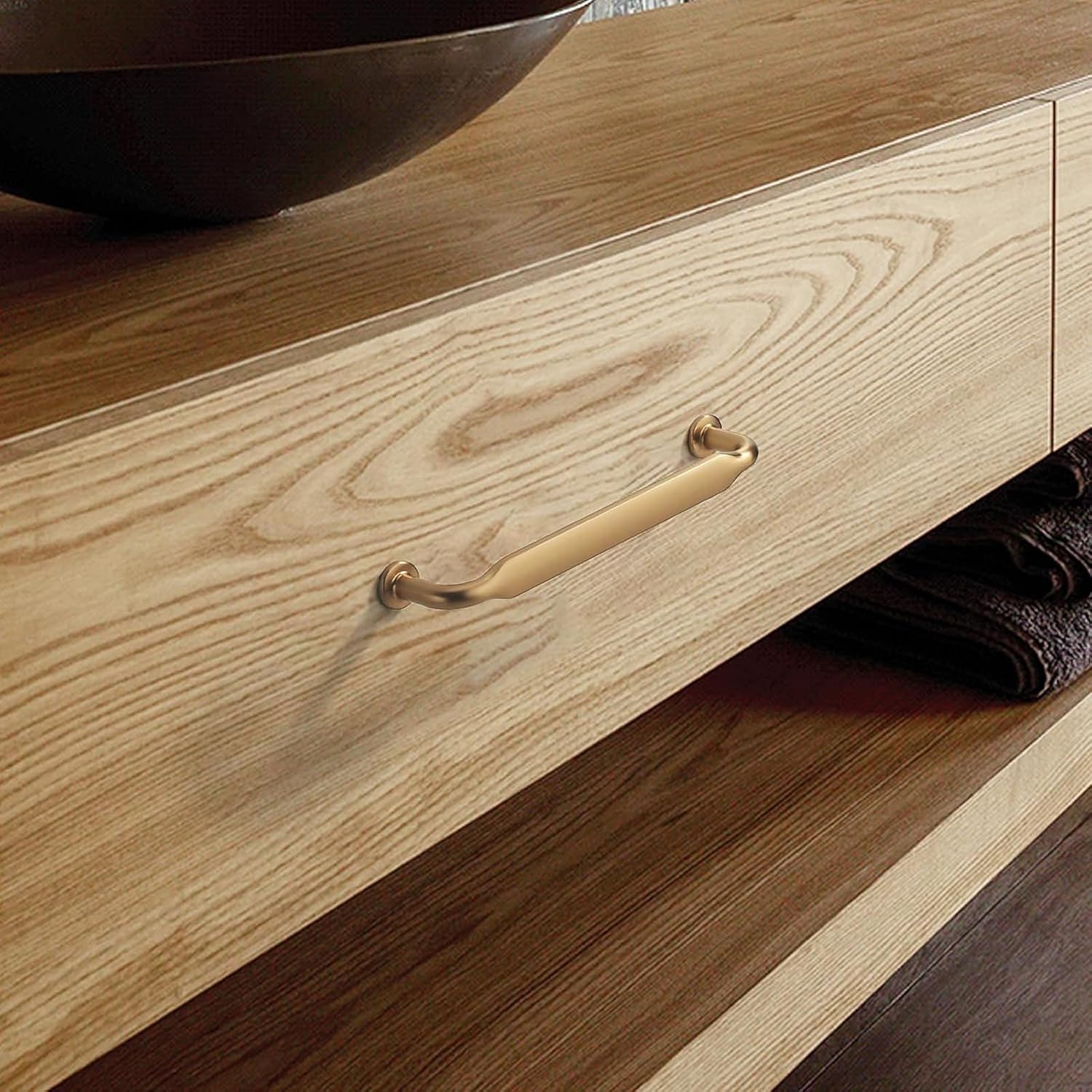
A cup pull is a curved, scoop-shaped pull mounted with two screws. The curve faces outward, and your fingers slip underneath to open the drawer. Cup pulls are almost exclusively a drawer application — they look proportionally odd on doors and offer less mechanical leverage for a full-height door pull. In champagne bronze, cup pulls read as a vintage or transitional design signal. Apartment Therapy’s 2025 kitchen hardware coverage repeatedly pairs them with shaker-style cabinetry in cream or sage, specifically calling out the combination as quietly elevated.
Cup pulls are also the most budget-accessible of the three silhouettes in champagne bronze. Because the shape is simpler to manufacture than a precision-machined bar pull, entry-level versions in PVD-coated zinc alloy are widely available at lower per-piece prices — making them a practical starting point for buyers who want the champagne bronze look without committing to premium per-unit costs across a full kitchen.
Where they shine: Upper drawer banks, spice drawers, drawer stacks on a kitchen island. Anywhere a knob would feel fussy but a bar pull would feel too industrial.
Where they fall short: Full-overlay frameless cabinet doors, where the cup’s visual weight can look undersized. Doors wider than 18 inches, where one cup pull doesn’t provide enough grip leverage.
Franklin
$15.00
In stock on Amazon
Check price on AmazonBar Pulls — The Mid-Range Workhorse
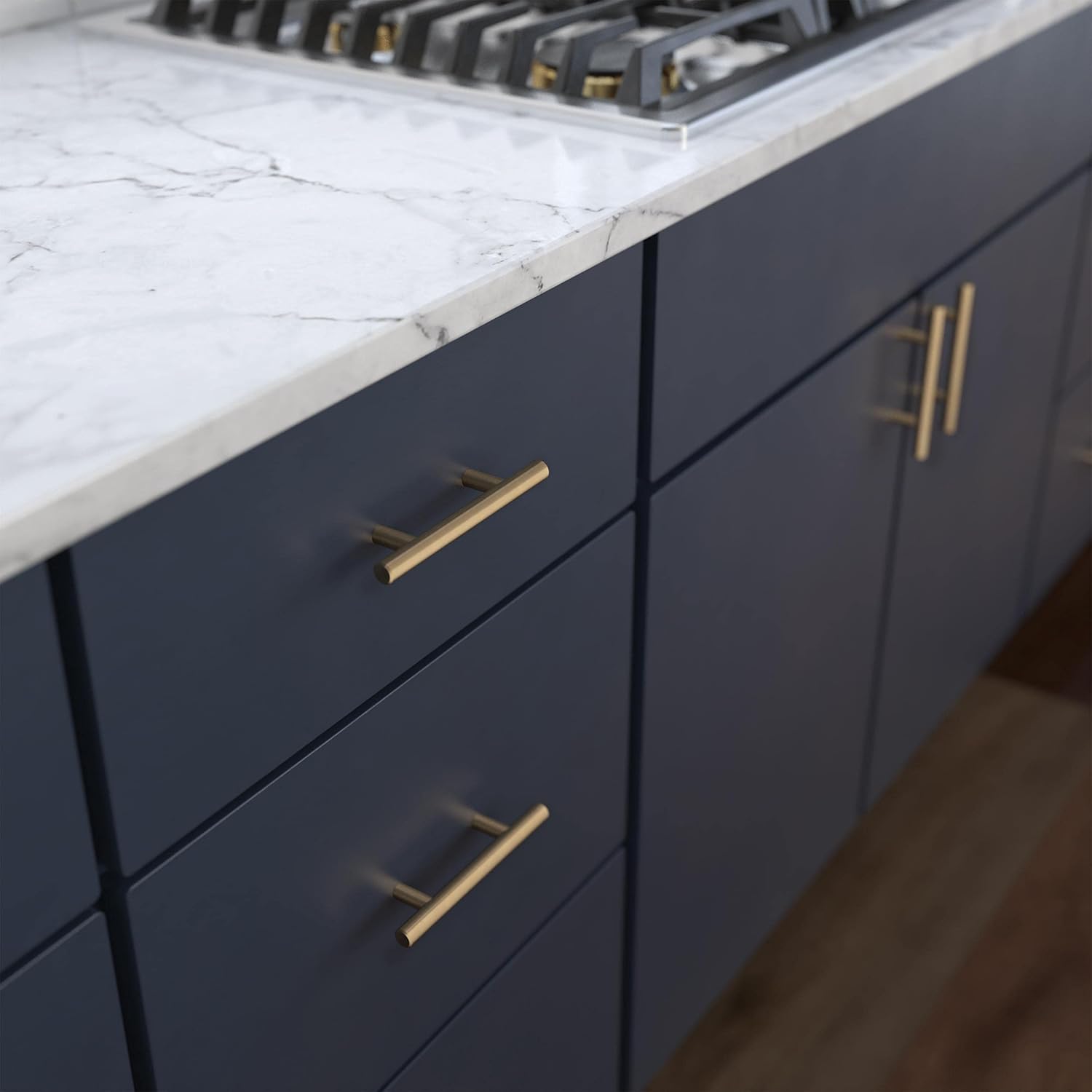
Bar pulls are the long, cylindrical or rectangular handles mounted on two screw holes spaced apart — typically 3, 5, or 6¼ inches center-to-center (the distance between the two mounting holes). They are the workhorse of modern and transitional kitchens and work on both drawers and doors. In champagne bronze, bar pulls provide a cleaner, more architectural line than cup pulls — they tend to read warmer and more contemporary in finished kitchen photography.
This is where the mid-range champagne bronze market is most competitive. Brands at this tier typically use solid zinc alloy or brass cores with PVD (physical vapor deposition) coating, which is more durable than spray lacquer and holds the champagne bronze tone better over years of use. The NKBA — the National Kitchen and Bath Association — addresses sizing logic directly in its Hardware Sizing and Placement Guidelines (2024 edition): for visual balance, pull length should span roughly one-third of the drawer or door width. A 5-inch or 6¼-inch bar pull on a base cabinet door sits within that ratio for most standard 15- to 18-inch drawer fronts and is one of the most balanced combinations in contemporary kitchen design.
Where they shine: Cabinet doors (especially 30-inch uppers and 36-inch lowers), oversized drawers, pantry doors.
Where they fall short: Small spice drawers or narrow 9-inch base pull-outs, where a long bar pull looks mismatched. Highly ornate traditional cabinetry, where a simple bar pull can feel anachronistically minimal.
Asidrama
$24.41
In stock on Amazon
Check price on AmazonKnobs — The Premium Door Hardware Play
Knobs are single-mount (one screw, one hole). They’re typically used on doors in traditional and transitional kitchens. In a champagne bronze finish, a round or faceted knob reads as classic. At the premium tier, champagne bronze knobs are often solid brass or forged with machine-cut faceting — details that justify higher per-piece costs and produce a finish depth that PVD-on-zinc versions cannot replicate.
Knobs are also the most forgiving on installation. One hole is easier to align than two, which matters if you’re rehardwaring a kitchen where the old holes do not match new hardware center spacing. This Old House, in “How to Choose Cabinet Hardware,” specifically flags single-hole knobs as the preferred choice when existing cabinet holes cannot be easily relocated — a practical consideration in renovation projects where drilling new holes means patching old ones.
Where they shine: Upper cabinet doors, bathroom vanity doors, any door where a pull would project too far into a traffic path.
Where they fall short: Drawers — knobs on drawers feel dated in most contemporary kitchens and provide less ergonomic leverage than a pull. For drawers, default to a cup pull or bar pull regardless of your door hardware choice.

Asidrama
$31.73
In stock on Amazon
Check price on AmazonBy the Numbers: Hardware Quantities for a Standard 10×10 Kitchen
The NKBA Hardware Sizing and Placement Guidelines (2024 edition) provide a clear baseline formula: one pull per drawer front for drawers under 24 inches wide, and two pulls centered symmetrically for drawers 24 inches and wider. Use this as your foundation before building a shopping list.
| Hardware Type | Typical Placement | Approximate Quantity (10×10 Kitchen) |
|---|---|---|
| Knobs (doors) | Upper and lower cabinet doors | 18–24 |
| Bar or cup pulls (drawers) | All drawer fronts | 8–12 |
| Bar pulls (doors, optional) | Lower base doors instead of knobs | 10–14 |
A useful workflow noted across aggregated Houzz reviews for champagne bronze projects: buyers report counting placements by walking through each cabinet run — upper doors, lower doors, drawer stacks — and recording each piece individually before placing any order. Verify against your actual cabinet layout before finalizing quantities. A 9-inch spice pull-out needs a short pull; a 36-inch pot-and-pan drawer may need two. Neither assumption generalizes from an average.
Finish Quality Signals Worth Knowing Before You Order
Across aggregated owner reviews for champagne bronze hardware on Houzz and published retailer roundups, two quality signals appear consistently as positive indicators.
Individual protective packaging. Reviewers across multiple champagne bronze product lines specifically mention individually wrapped or bagged pulls as a positive quality signal. This matters more for champagne bronze than for matte black or brushed nickel because the warm metallic PVD or lacquer coating on champagne bronze finishes shows fine scratches more visibly. Hardware that ships loose in a single poly bag — or with other hardware pieces — arrives with contact scratches more often. If a brand’s product listing does not mention individual packaging, that is worth a direct inquiry before ordering 25 pieces.
Finish consistency in multi-SKU product lines. Published owner review data includes documented incidents of buyers receiving a single mismatched piece — a different sheen or color — inside an otherwise correct pack. This is a multi-finish SKU risk: brands selling the same pull in six or more finishes carry more picking-error risk at the warehouse. For champagne bronze orders specifically — where the finish is already nuanced and variable — verify each piece against the others when the box arrives, before drilling a single hole. Return windows close fast, and a single installed wrong-finish pull changes the return calculus entirely.
Plumbing fixture matching. Aggregated Houzz owner reviews for several champagne bronze hardware lines include specific accounts of successful finish matching to Delta’s champagne bronze faucet family. This is a useful reference point: if your plumbing fixture is Delta champagne bronze, cross-referencing owner reviews that mention Delta by name is one of the more reliable methods for identifying candidate hardware brands. As always, order a single piece first and hold it next to the installed faucet before ordering in quantity. Moen’s champagne bronze reads slightly differently from Delta’s version, so treat each fixture brand as its own matching problem.
Frequently Asked Questions
Is champagne bronze the same color as brushed brass or brushed gold? No — but they are close enough to cause real confusion. Brushed brass tends to be brighter and more yellow-gold. Brushed gold is often the brightest of the three. Champagne bronze is the most muted and warm-beige of the group, with visible bronze or brown undertones. In low light, champagne bronze can read almost antique. In bright natural light, it reads more golden. When in doubt, request a physical sample before ordering in volume.
Will champagne bronze hardware match my Delta or Moen champagne bronze faucet? It depends on the hardware brand. Delta’s champagne bronze is a specific proprietary finish. Owner reviews aggregated on Houzz suggest some hardware brands match Delta fixtures reliably, while others do not. Moen’s version reads slightly differently. The only reliable method is to hold a sample pull next to your installed faucet before ordering the full set. Brand-to-brand matching from a product description alone is not reliable.
Should I use cup pulls on drawers and bar pulls on doors, or can I mix? Mixing is common and generally accepted in transitional kitchens. A popular combination is cup pulls on upper drawer banks with bar pulls on base cabinet doors. What matters is internal consistency: pick your mixing logic and apply it across the whole kitchen. Do not mix cup pulls and bar pulls on the same drawer bank — that reads as unfinished rather than intentional.
What is the difference between a 3-inch and 5-inch hole center, and how do I know which I need? The hole center measurement — also called center-to-center, or CC — is the distance between the centers of the two mounting holes. A 3-inch CC pull works well on narrow drawers (12–18 inches wide). A 5-inch CC pull suits wider drawers and doors. The NKBA Hardware Sizing and Placement Guidelines (2024 edition) suggest the pull length should span roughly one-third of the drawer or door width for visual balance. Measure your drawer fronts before ordering.
Can I return champagne bronze hardware if the color doesn’t match my kitchen once installed? Generally, no — once hardware is installed (holes drilled), most retailers treat it as used and non-returnable. This is why the sample-first workflow is not optional for champagne bronze. Order one pull, hold it against your cabinetry and fixtures for a full day in your kitchen’s actual light, and only then place the full order.
The Decision Rule
If your kitchen has warm white, cream, or greige cabinetry with existing warm-metallic plumbing fixtures: champagne bronze hardware is the right finish category — but the right brand depends on which specific champagne bronze matches your faucet. Order singles first, always.
If you are choosing between cup pulls and bar pulls: use bar pulls on doors and cup pulls or bar pulls on drawers, based on your cabinetry style. Cup pulls on doors almost always look undersized relative to the door panel.
If you are counting hardware for a full project: use the NKBA placement formula — one pull per drawer under 24 inches, two for wider drawers; one pull or knob per door — build your quantity list before you order, and add two to three pieces as buffer for damage or future replacements. Champagne bronze finishes can be discontinued or shift slightly between production runs, and matching a replacement piece two years from now is harder than stocking a couple of extras today.