If you’ve got a drawer that drags, sags, or won’t close flush, you’ve probably stared at it and wondered whether you need to order a whole new set of slides — or whether something smaller is broken. Drawer slides are the metal tracks (mounted either on the sides or underneath a drawer) that let it roll in and out smoothly. The most common failure point isn’t the track itself; it’s a small plastic or metal clip called a rear-mount bracket — the piece that anchors the back end of the slide to the inside of the cabinet. These brackets cost a few dollars. A full slide replacement costs $10–$40 per drawer and an hour of focused work. Getting the diagnosis right before you order anything saves you time, money, and a second trip to your supplier. This guide walks through exactly that decision — with real-world install notes from owners who’ve been there.
| EDITOR'S PICKLONTAN Soft Close Drawer Slides… | Mid-tierPrime-Line R 7265 Drawer Track… | Budget pickPrime-Line R 7240 Drawer Side T… | |
|---|---|---|---|
| Slide type | Ball bearing | Back plate | Side bracket |
| Mount | Side | — | Side |
| Length | 22 in | 3/8 x 1 in | — |
| Weight limit | 100 lb | — | — |
| Soft close | ✓ | — | — |
| Sold as | 10 pairs | 1 pair | 1 pair |
| Price | $110.48 | $5.67 | $4.99 |
| See on Amazon → | See on Amazon → | See on Amazon → |
Step One: Diagnose Before You Order Anything
The single most useful move you can make before touching your credit card is to pull the drawer completely out of the cabinet and look at the rear of both slides.
Signs the rear bracket is your whole problem:
- The slide is intact, rolls smoothly when you move it by hand, but the back end flops or has visibly separated from the cabinet wall
- The drawer sits noticeably lower on one side or cocks at an angle when you push it in
- You can see a cracked, broken, or missing plastic clip at the back of the cabinet
Signs you need full slide replacement:
- The slide itself is bent, corroded, or the ball-bearing cage has collapsed
- The drawer binds at the same point in every pull cycle regardless of which side you push
- The telescoping sections of the slide no longer extend and retract smoothly even when you hold the slide in your hand, outside the cabinet
- The slide has no rear bracket failure but still won’t support the drawer’s weight evenly
Family Handyman’s guide on fixing drawer slides notes that bent or racked slides almost never respond to bracket swaps — once the track geometry is compromised, the drawer will keep binding no matter how well the bracket is seated. That’s worth taking seriously before you order the cheaper fix.
The in-cabinet test that saves you the disassembly guesswork: With the drawer removed, grab the back end of each slide and try to wiggle it vertically. A secure, functional rear bracket should give you almost zero movement. More than about 3mm of vertical play — or any lateral rotation — and the bracket is either broken or has pulled free of its mounting point.
The $4 Fix: What Rear-Mount Brackets Actually Do and When They Work
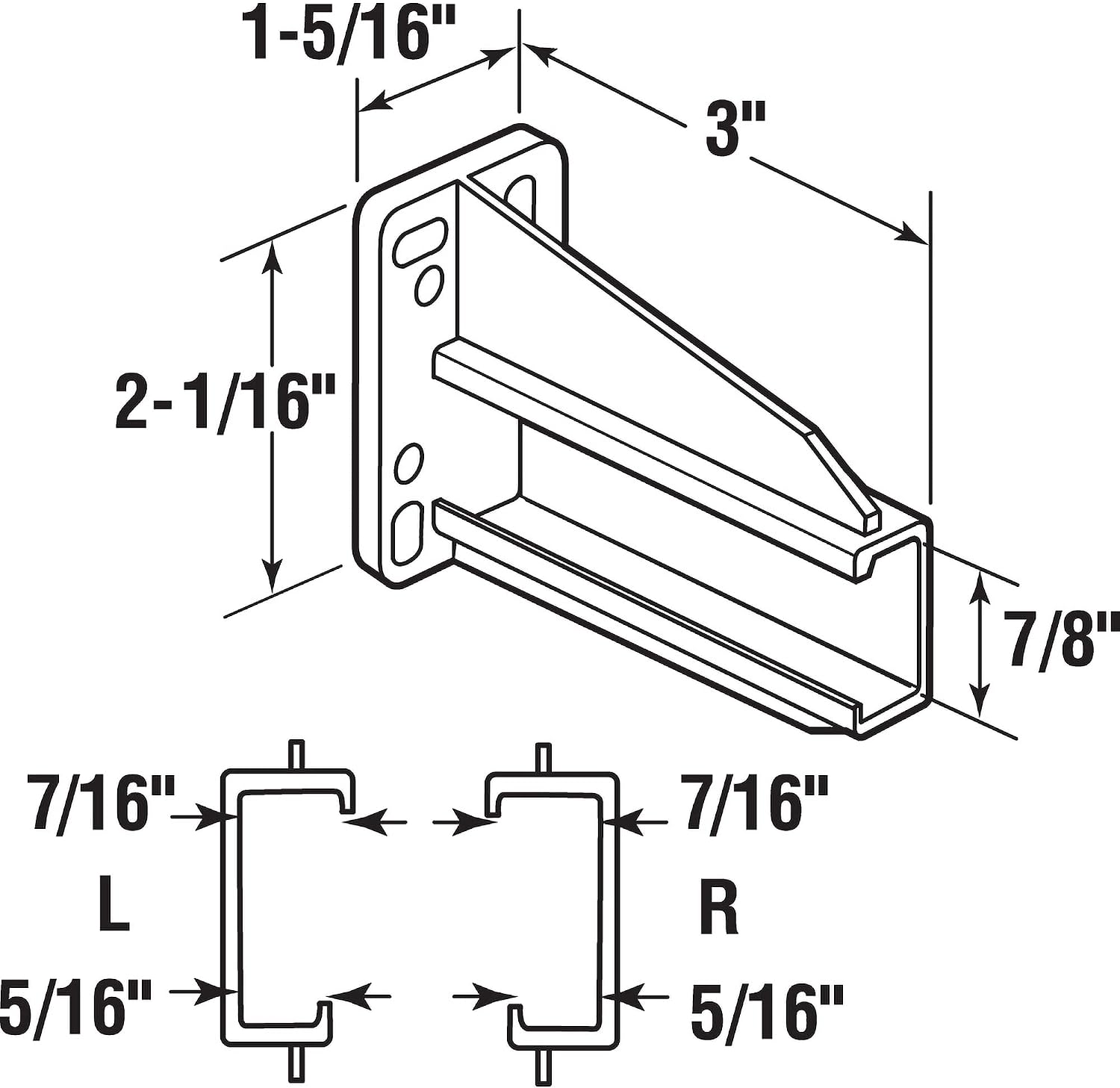
The Prime-Line R7265 is the bracket most owners reach for first, and reviewing the aggregated feedback on Houzz reveals a useful pattern worth naming directly.
A significant share of buyers report purchasing the bracket without measuring their original — and it fits anyway. That’s not luck; it’s because a small number of bracket form factors cover the overwhelming majority of epoxy-coated steel slides manufactured from the late 1980s through the mid-2000s. Merillat cabinets come up by name repeatedly in R7265 reviews, which makes sense: Merillat was one of the dominant semi-custom brands in that era, and their OEM rear brackets have been discontinued. Owners searching for a Merillat-specific replacement find the Prime-Line bracket is a functional substitute.
The more instructive story, though, is the reviewer who did compare dimensions before ordering and still needed a minor modification — a small amount of material removed with a pocket knife to get the bracket to seat flush. That detail matters for practitioners: the bracket may be close enough in footprint but slightly oversized for a specific channel depth, and a quick trim is part of the install, not a sign of a defective part. If you’re doing multiple cabinets on a flip or a multi-room renovation, budget five minutes per drawer for minor fitting.
By the numbers — repair vs. replacement cost estimate (10-drawer kitchen):
| Scenario | Parts cost | Labor estimate | Total |
|---|---|---|---|
| All 10 need rear brackets only | ~$15–$25 | 1.5–2 hrs DIY | ~$15–$25 |
| 4 brackets + 6 full slide pairs | ~$80–$120 | 3–4 hrs DIY | ~$80–$120 |
| 10 full soft-close slide replacements | ~$100–$200 | 4–6 hrs DIY | ~$100–$200 |
Parts cost estimates based on current (May 2026) street pricing across major hardware supply channels.
Do you need to know your cabinet brand to order the right bracket? Not necessarily — but you do need to measure. The two dimensions that matter are the width of the slide channel where the bracket seats, and the thickness of the bracket tab that hooks over the back of the slide. Per aggregated owner reviews on Houzz, most 3/4-extension epoxy slides from major domestic manufacturers fall into a narrow range. If your slides are metric (common in European-style frameless cabinets), measure carefully — the Prime-Line bracket is engineered for inch-standard slides.
Full Slide Replacement: Reading the Specs Before You Order
When the bracket isn’t the problem, you’re choosing a new slide. Three considerations dominate this decision for practitioners: mounting hole compatibility, soft-close retrofit geometry, and full-extension behavior.
Will soft-close replacement slides fit your existing holes?
This is the question owners ask most often, and the honest answer is: sometimes yes, often no. Per This Old House’s installation reference on replacing cabinet drawer slides, the industry has not standardized on hole spacing between soft-close and non-soft-close side-mount slides. You may get lucky if you’re replacing a slide from the same manufacturer family. More commonly, you’ll be driving one or two new pilot holes per slide — which is a 10-minute task, not a project-stopper, but it means you cannot rely on existing holes alone.
For frameless (European-style) cabinets, side-mount soft-close slides are the standard retrofit path and alignment is generally forgiving. For face-frame cabinets — the traditional American style where a solid wood frame is glued to the front of the cabinet box — side-mount slides work but require either a filler strip to bring the slide flush with the face frame, or a slide specifically rated for face-frame use with an offset bracket. Undermount slides (which attach to the bottom of the drawer box rather than the sides) are the cleaner upgrade for face-frame kitchens and hide all the hardware, but they require at least 1/2” of clearance under the drawer box and a drawer box bottom thick enough to accept the clip. If you’re upgrading a face-frame kitchen built before 2000, measure the clearance under each drawer box before specifying undermount.
The LONTAN retrofit alignment note
LONTAN soft-close retrofit slides come up frequently in owner reviews as a well-priced full replacement option. The honest note from owners who struggled: the challenge is calibration, not product quality. Reviewers who reported sticking or misalignment consistently traced it back to the left and right slides not being mounted at precisely the same height. Once re-leveled, the slides performed well. The lesson for a practitioner is to use a story pole or mark both sides of the cabinet at the same time with a single reference line before driving any screws — don’t measure each side independently.
The 3-fold full-extension slide and pull-out trash cabinet reality
Gobrico’s 3-fold full-extension slides — the kind that extend the drawer 100% out of the cabinet on three telescoping sections — come up repeatedly in the context of pull-out trash cabinet drawers. One owner’s note about a trash-can drawer that “kept getting stuck” is a useful real-world case. Three-fold slides are longer in their collapsed state than standard two-section slides. In a trash pull-out with a relatively short cabinet depth (18” or less), the collapsed slide can interfere with the door or the frame at full close. Verify your cabinet interior depth against the slide’s collapsed length spec before ordering. Standard kitchen base cabinets (24” deep) accommodate most 3-fold slides without issue; pantry pull-outs and narrow bath vanities are where this bites people.
The screw count detail most install guides skip
Homdiy soft-close slide reviews surface a practical note worth passing on directly: several owners report that the screws included in the packaging are insufficient for the slide’s rated load capacity. This isn’t a defect claim — it appears to reflect packaging that bundles a minimal screw count optimized for lightweight drawer boxes. If you’re installing slides under a drawer that will carry significant weight (pots and pans, full utensil drawers, anything over roughly 50 lbs.), supplement with your own #8 x 1” pan-head screws into solid wood or use appropriate anchors if you’re mounting into furniture board.
Frequently Asked Questions
How do I know whether my drawer problem is a bracket failure or a full slide failure without pulling everything apart? Pull the drawer out completely and hold each slide in your hand. If it telescopes smoothly and shows no visible bending or corrosion, the slide is likely fine and you’re looking at a bracket issue. If the slide binds, grinds, or won’t extend evenly when you manipulate it by hand, replace the slide.
Do I need to know the brand of my cabinets to order the right Prime-Line rear bracket, or can I just match dimensions? Match dimensions. The bracket’s seating width and tab thickness are what determine fit, not the cabinet brand name. Measure both before ordering — a $4 bracket returned because of a 2mm mismatch wastes more time than a quick pre-order measurement.
Will soft-close replacement slides fit in the same mounting holes as my original non-soft-close slides? Usually not reliably. Hole spacing varies by manufacturer and era. Plan to drive new pilot holes; the existing holes may still be usable for one or two screws per slide, but don’t design your install around them.
Can I install new drawer slides without removing the cabinet from the wall? Yes, in almost all cases. Base cabinets are accessed from the front — you’re working inside the cabinet box. Wall cabinets are tighter but still accessible. The only scenario that complicates in-place installation is a blind corner cabinet where physical access to the back wall is genuinely limited.
What is the correct way to measure for replacement drawer slides — do I measure the drawer box or the cabinet opening? Measure the interior depth of the cabinet opening, not the drawer box. Slide length should match the cabinet depth (typically 20” or 22” for standard base cabinets). The drawer box is built to be slightly shorter than the slide to allow clearance.
Are side-mount soft-close slides compatible with face-frame cabinets, or do I need undermount slides for that cabinet type? Side-mount slides work in face-frame cabinets but often require a wood filler strip (typically 3/4” thick) mounted inside the cabinet to bring the slide surface flush with the face frame opening. Undermount slides are the cleaner option if your drawer box bottom and clearance dimensions allow it.
The Decision Rule
If the slide moves smoothly by hand and the rear bracket is broken or missing — buy the bracket. Spend 20 minutes on the install and call it done.
If the slide itself is bent, corroded, or binding — replace the slide. Match the length to your cabinet depth, confirm your face-frame situation before choosing side-mount vs. undermount, and bring your own screws if load matters.
If you’re doing a full kitchen refresh and want soft-close throughout — budget for new holes, use a reference line across both sides of each cabinet before you drive the first screw, and check the collapsed length of any 3-fold slide against your actual cabinet depth before ordering. The alignment work is where the install time goes; the slides themselves are forgiving once they’re level.