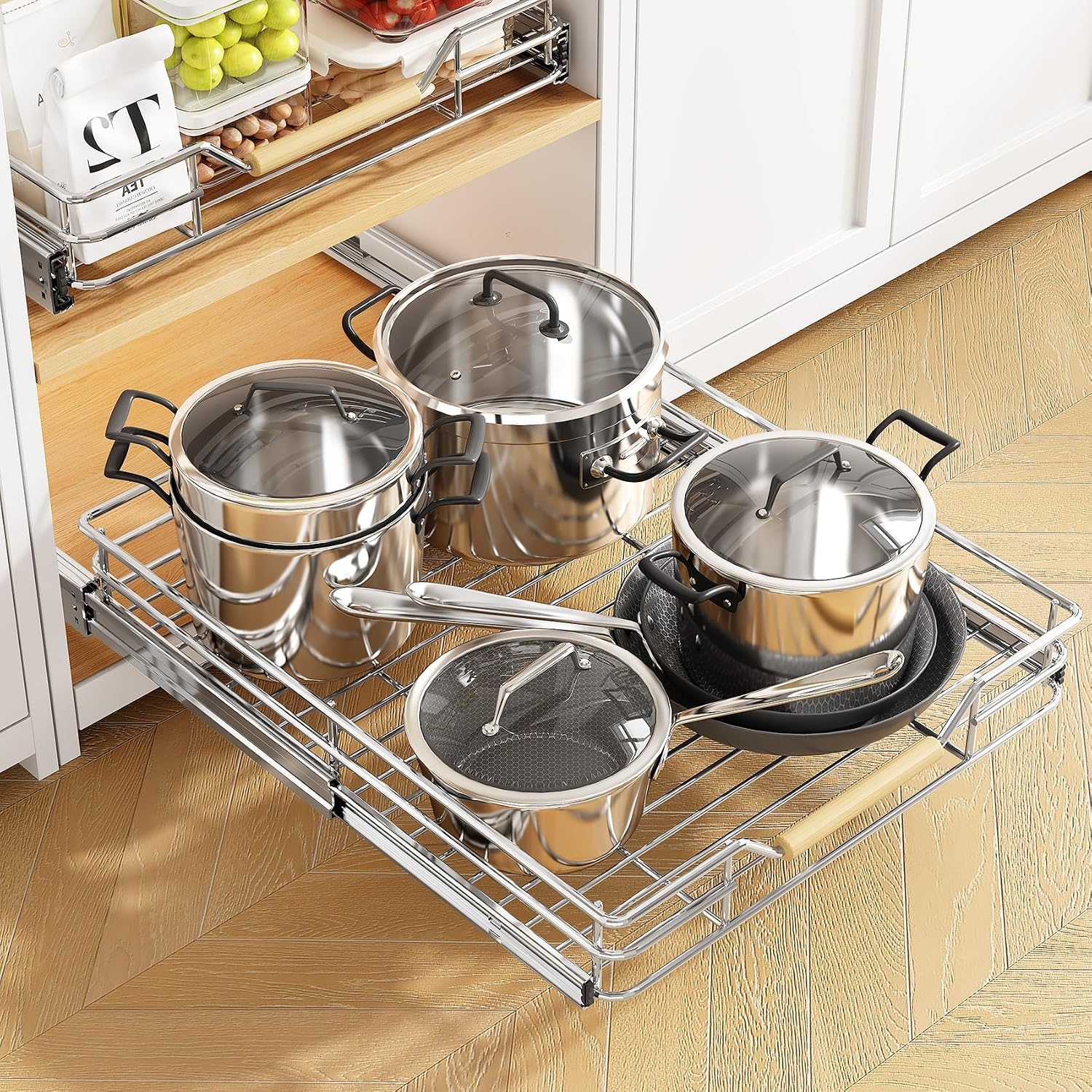
If you’ve ever gotten down on your hands and knees to fish a Dutch oven out of the back of a base cabinet — the kind that’s 24 inches deep and seemingly designed to hide everything you need — you already understand the problem this article solves. A pull-out organizer (also called a roll-out shelf or drawer slide organizer) is a platform that mounts inside your existing cabinet and glides forward on metal tracks, so the full depth of the cabinet comes to you instead of making you reach blindly into a dark corner. There are two main types compared here: expandable-width organizers, which telescope to fit a range of cabinet openings, and fixed-width roll-out shelves, which come in a single predetermined dimension (commonly 15 inches). Both solve the same access problem, but they make different tradeoffs on installation time, stability under load, and fit precision. If you’re mid-project right now — sourcing organizers for a kitchen reno, a flip, or a client’s spec — here’s what the specs and owner reviews tell us about which one earns a spot in your cabinets.
One thing the reviews make unmistakably clear before we get into specs: this product category has an accessibility dimension that goes well beyond “nice to have.” Across aggregated Houzz homeowner reviews, multiple buyers describe pull-out organizers as genuinely life-changing — not just convenient. Reviewers with difficulty bending, chronic back pain, post-surgical mobility restrictions, and knee problems consistently single these out as the upgrade that made their kitchen functional again. The NKBA Kitchen Planning Guidelines specifically call out accessible reach zones for universal design, and roll-out shelves are one of the primary hardware solutions that bring a standard base cabinet into that accessible range without a full remodel. If you’re speccing a kitchen for an aging-in-place client or a multigenerational household, this isn’t a luxury line item.
| EDITOR'S PICKPAKETA 4 Pack Expandable Pull O… | Mid-tierPull out Cabinet Organizer | Budget pickKitstorack Under Sink Organizer | |
|---|---|---|---|
| Width | Expandable | 15"W | — |
| Depth | 21" | 21" | — |
| Slide Rails | 3 | — | — |
| Mounting | Adhesive | — | — |
| Tiers | — | — | 2 |
| Pack Count | 4 Pack | — | — |
| Price | $84.99 | $39.97 | $39.08 |
| See on Amazon → | See on Amazon → | See on Amazon → |
The Core Tradeoff: Expandable vs. Fixed-Width
The two formats solve the same problem through different engineering assumptions. Understanding where each format wins — and where it breaks down — is the fastest path to ordering the right one the first time.
Expandable-Width Organizers
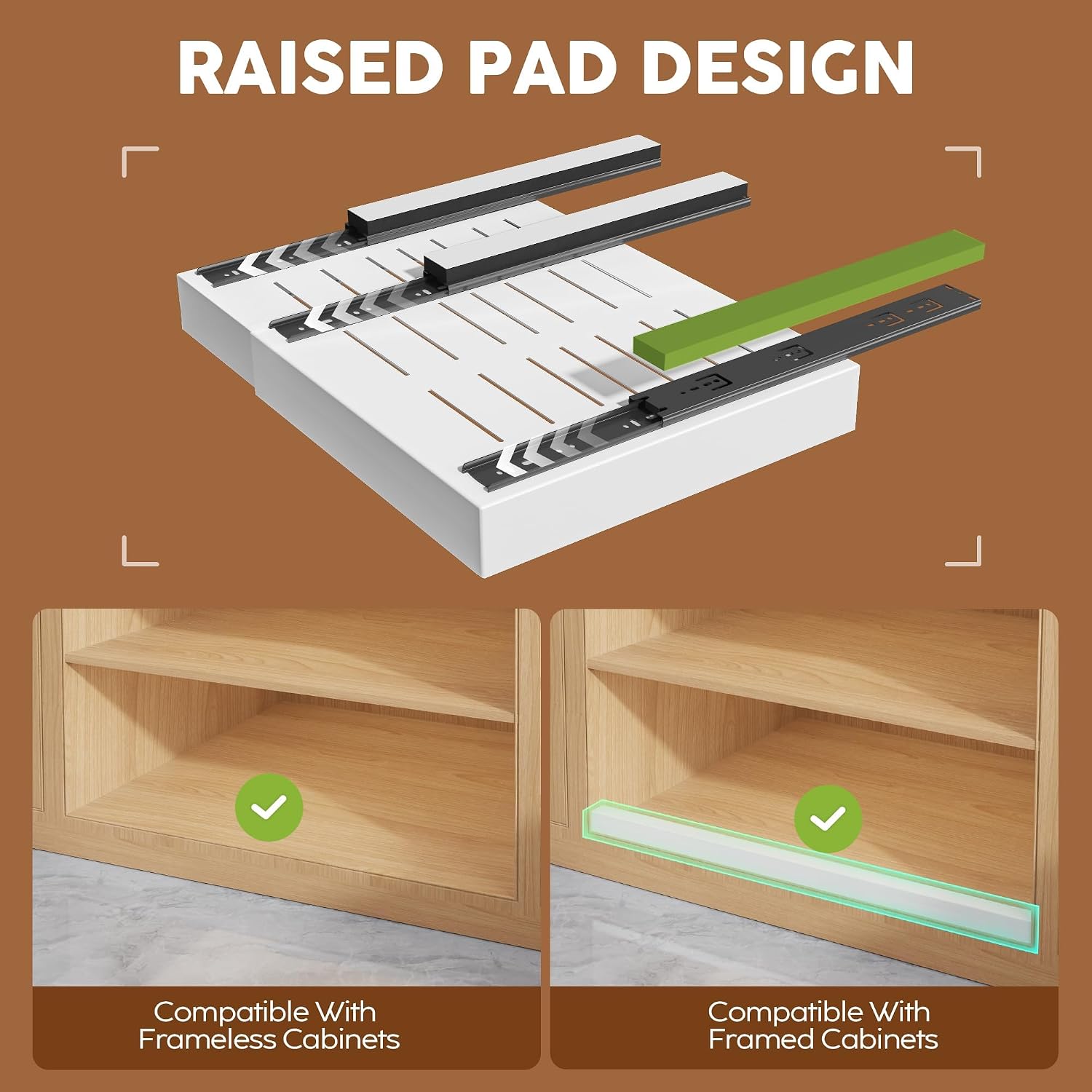
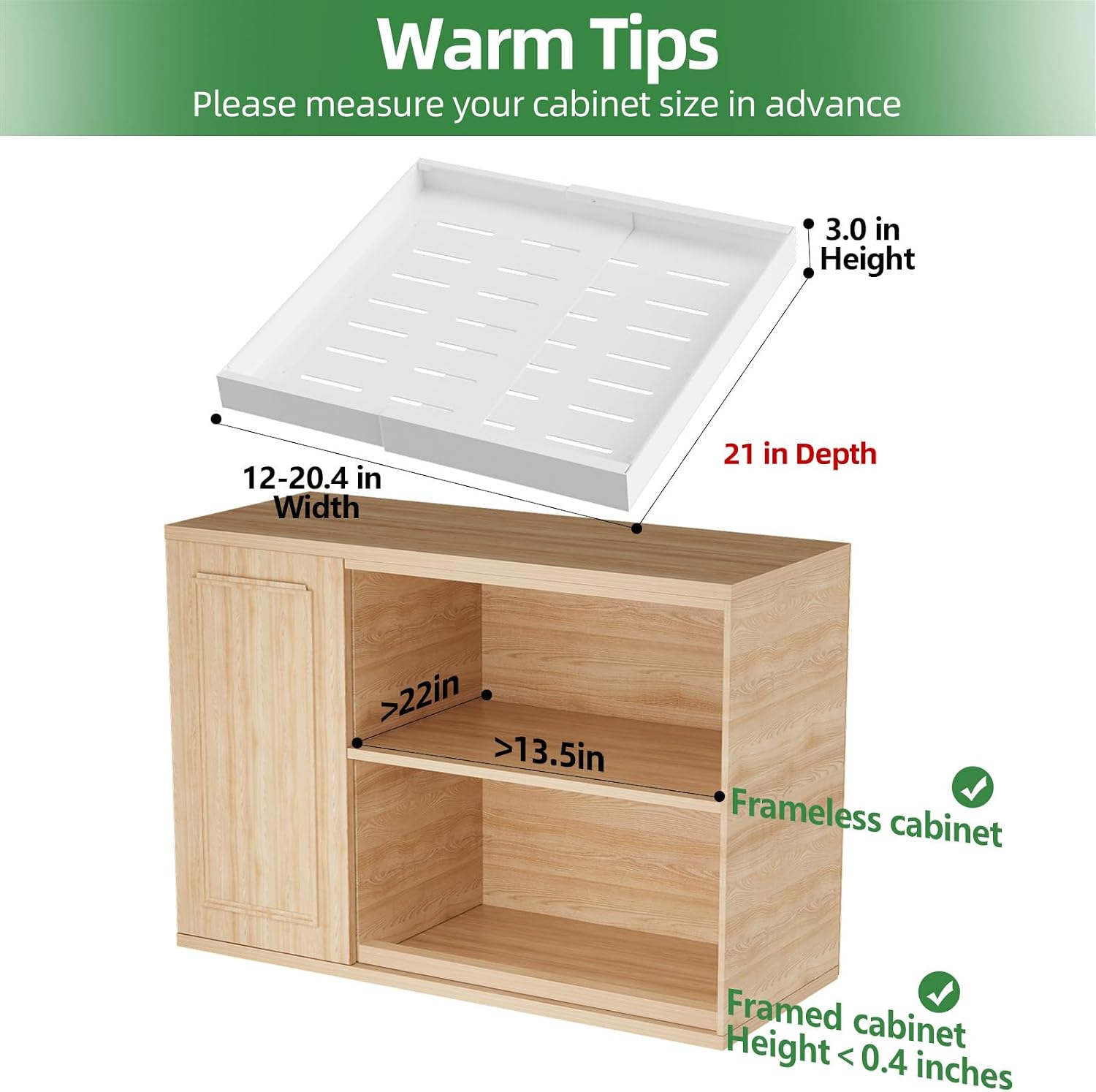
Expandable organizers use a telescoping frame that adjusts to a range of interior cabinet widths, typically spanning roughly 11 to 20 inches. The core appeal is flexibility: one SKU can serve a kitchen with 15-inch, 18-inch, and 21-inch base cabinets without requiring a separate product order for each opening. For a multi-cabinet project or a renovation where cabinet widths vary across a run, the expandable format reduces SKU complexity substantially.
The critical installation detail — one that product listings frequently understate — is that the telescoping width adjustment does not mechanically lock without screws. When the frame is set to width and secured only with the included adhesive pads, the joint can shift laterally under dynamic load, particularly with heavier cookware. Owners who installed with adhesive only and loaded the shelf with cast iron cookware reported lateral creep, sometimes within weeks of installation. Owners who drove two screws per slide into the cabinet floor reported no movement.
This Old House’s published guidance on roll-out shelf installation notes that slide mounting points should be fastened to a fixed substrate, and that adhesive alone is appropriate for light-duty applications but not for hardware bearing repeated dynamic load from pots and pans. That aligns precisely with what reviewers surface in practice. The decision rule for expandable organizers: if you cannot or will not drill into the cabinet floor, reserve this format for light pantry loads only.
Kitstorack
$39.08
In stock on Amazon
Check price on AmazonFixed-Width Roll-Out Shelves
Fixed-width roll-out shelves — most commonly manufactured at 15 inches — arrive as a rigid, factory-assembled frame. There is no adjustable joint, which means there is no joint to shift. Family Handyman’s published coverage of roll-out tray installation notes that a well-fitted fixed-width tray in a matching cabinet opening requires minimal shimming or adjustment, which is why owners consistently report the fastest installs in this category. One reviewed owner clocked a 5-minute install. That’s best-case, but it illustrates the advantage of starting with a rigid frame that doesn’t require user-set width calibration.
The tradeoff is obvious: a fixed 15-inch shelf fits a 15-inch face-frame opening and nothing else without modification. If your cabinet run includes multiple widths, you’re ordering multiple SKUs. For a uniform-width kitchen — common in production builds and tract homes — this is a non-issue. For a custom or older kitchen with varied openings, it compounds ordering complexity.
Pull
$39.97
In stock on Amazon
Check price on AmazonSide-by-Side Spec Summary
| Spec | Expandable (telescoping frame) | Fixed-Width 15” Roll-Out |
|---|---|---|
| Width range | ~11”–20” adjustable | Fixed at 15” |
| Typical weight rating | 50–100 lbs (manufacturer-rated) | 75–100 lbs (manufacturer-rated) |
| Install time (owner-reported) | 15–30 min with screws | ~5 min (fastest in class) |
| Adhesive-only stability | Conditional — shifts under load at adjustable joint | Generally stable (no adjustable joint) |
| Best fit scenario | Mixed cabinet widths, light loads in no-drill installs | Single-width run, heavy loads, maximum stability |
| Slide mechanism to prioritize | Ball-bearing (avoid nylon roller on heavy loads) | Ball-bearing for long-term durability |
PAKETA
$84.99
In stock on Amazon
Check price on AmazonUnder-Sink Organizers: The Plumbing Clearance Problem
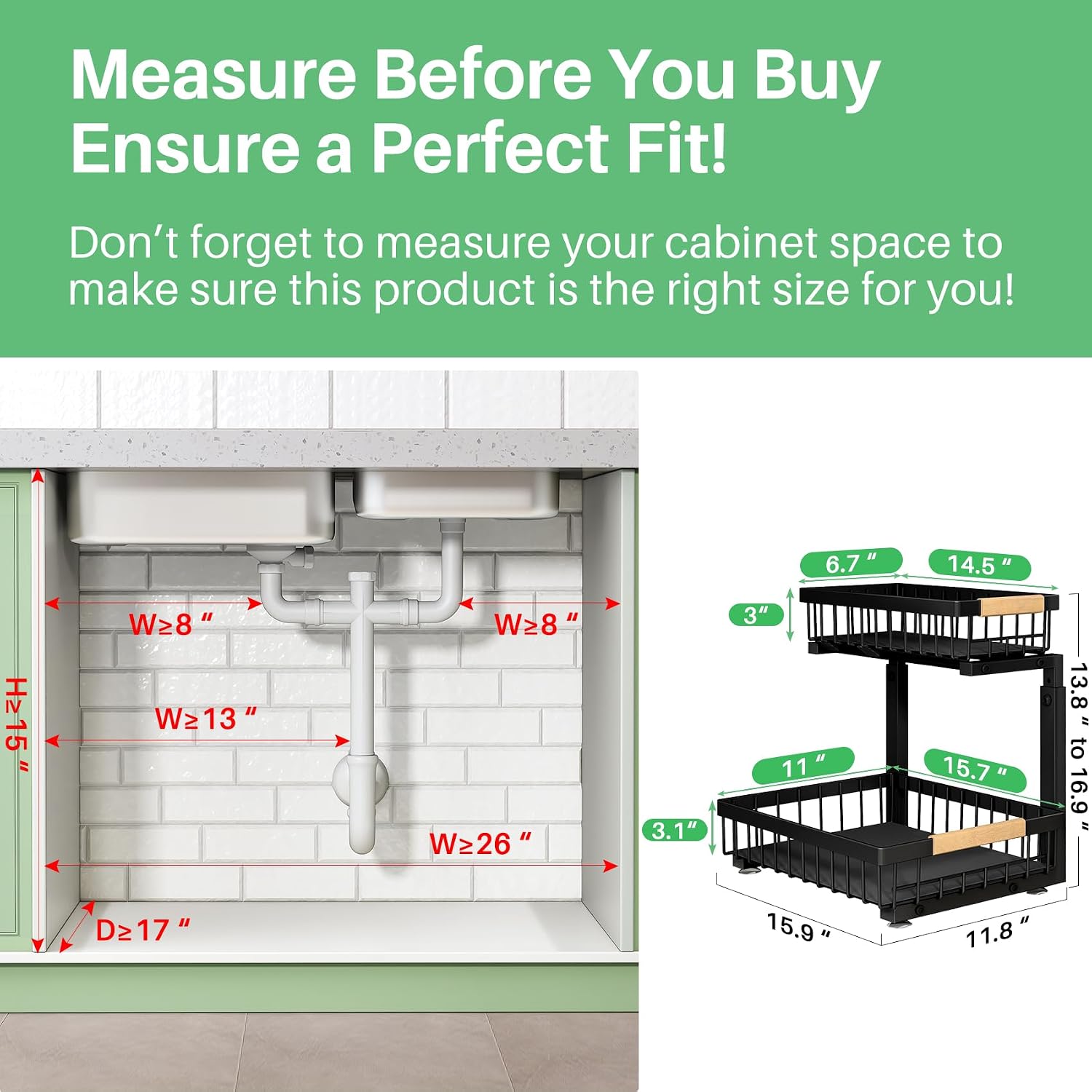
If any part of this project involves an under-sink cabinet, the product selection logic shifts significantly. Under-sink base cabinets are the one location where fixed-height organizers fail in a predictable and frequently reported way: the garbage disposal unit or the P-trap drain assembly (the curved pipe visible under most sinks) blocks the organizer’s footprint, and a fixed-height shelf either sits too low to clear the plumbing or is too shallow to be useful.
Apartment Therapy’s published analysis of under-sink organizers specifically flags this issue, identifying the adjustable-leg feature on newer under-sink pull-out designs as the decisive specification — not aesthetics, not width. Reviewers who purchased fixed-height under-sink organizers and returned them consistently cite the garbage disposal or P-trap as the obstacle.
The clearance math: a standard residential garbage disposal unit in the mid-range category typically requires 12 to 14 inches of vertical clearance below the sink basin. A P-trap assembly on a standard 36-inch-high sink runs roughly 8 to 10 inches below the cabinet floor. An organizer with adjustable legs that can raise the platform to clear those obstacles — while still leaving a usable storage surface — is the only configuration that reliably works across different plumbing configurations.
The practical spec to look for: adjustable legs with at least 4 inches of height range, and a platform depth that doesn’t force the organizer into the drain assembly’s footprint. If you’re sourcing for a client with a disposal, confirm clearance height before ordering any fixed-height product. This is not a measurement step you can skip.
Measuring Your Cabinet: The Step Most Buyers Skip
Owner reviews across Houzz and aggregated retail feedback surface a consistent mistake: buyers measure the exterior cabinet width or the face-frame opening and order accordingly, then discover the shelf doesn’t fit the actual interior box dimension — or vice versa. Here’s the measurement sequence that avoids a return:
- Measure the interior box width — not the door opening. On a face-frame cabinet (the most common style in North American kitchens), the face frame narrows the usable opening by 1 to 2 inches per side. A 15-inch face-frame opening typically corresponds to a 17 to 18-inch interior box.
- Measure the interior depth — standard base cabinets run 24 inches deep, but older construction varies. Your organizer’s pull-out depth should be 1 to 2 inches less than the cabinet depth to clear the face frame when fully extended.
- For expandable organizers, set the width approximately 1/4 inch narrower than the interior box measurement on each side — tight enough to stay positioned, loose enough to slide without binding.
- For fixed-width 15-inch shelves, confirm the face-frame opening (not the box) is at least 15 inches clear. In a standard 18-inch base cabinet with a face frame, this is typically fine. In a 12-inch filler cabinet or a narrow pull-out unit, it may not be.
The expandable format’s measurement tolerance is more forgiving — it accommodates minor variation in interior box width across a cabinet run. The fixed-width format requires a precise match to the face-frame opening, but rewards that precision with zero installation calibration.
Weight Ratings: What Manufacturers Claim vs. What Owners Load
Most expandable pull-out organizers in this category are manufacturer-rated at 50 to 100 lbs per shelf. Fixed-width roll-out shelves from established hardware suppliers typically carry similar ratings, with commercial-grade versions rated to 150 lbs. Reviewer behavior tells a more grounded story.
Across aggregated reviews, the vast majority of owners loading these shelves with pots, pans, small appliances, and pantry goods are operating well below the rated maximum. A 12-inch cast iron skillet, a Dutch oven, and a few lids will typically total 15 to 25 lbs. The weight rating becomes genuinely relevant in two scenarios: pantry cabinets loaded with canned goods (which can approach 40 to 60 lbs quickly) and under-sink cabinets where cleaning product collections accumulate over years.
In both cases, published manufacturer specifications for mid-range expandable organizers indicate adequate rated capacity — but owners in longer-run reviews report that the slide mechanism, specifically the ball-bearing track quality, degrades faster under consistent near-maximum load than under typical kitchen use. If you’re loading heavy, look for ball-bearing slides rated at the high end of the range and avoid budget-tier models with nylon roller slides. Family Handyman’s coverage of drawer slide hardware notes that ball-bearing full-extension slides outperform nylon roller slides in both load capacity and long-term smoothness under repeated use.
Frequently Asked Questions
Will an expandable organizer fit inside a face-frame cabinet opening that is narrower than the cabinet box? The expandable organizer’s width must fit the face-frame opening, not just the interior box — because the frame has to pass through the opening during installation. Measure the narrowest point of the opening first. If the face-frame opening is smaller than the organizer’s minimum width, you’ll need a fixed-width shelf sized to that opening.
Do I need to drill into the cabinet floor to install these securely, or will the adhesive strips hold pots and pans? For expandable organizers, adhesive-only installs can shift under heavy dynamic load, particularly at the adjustable width joint. Fixed-width roll-outs are generally more stable with adhesive alone because the rigid frame has no movable joint. For anything heavier than light pantry items, two screws per slide into the cabinet floor is the more reliable method for either format.
How do I choose between a 15-inch fixed shelf and an expandable organizer? Measure the interior box width, subtract 1/2 inch total for clearance, and check whether that dimension falls near 15 inches. If your cabinets are uniform width and close to 15 inches at the face-frame opening, the fixed-width shelf installs faster and stays more stable. If your cabinets vary in width or run wider than 18 inches, the expandable format offers more flexibility — provided you can commit to screwing it in.
Will an under-sink organizer clear a standard garbage disposal? Standard garbage disposals require roughly 12 to 14 inches of vertical clearance. Look for an under-sink organizer with adjustable legs that can raise the platform above the disposal housing. Confirm the leg-height range covers your specific disposal’s height before ordering.
Can I stack two of these organizers vertically in a tall pantry cabinet? Standard single-tier roll-out shelves are not independently stackable — they mount to the cabinet floor on slides. For a tall pantry, look specifically for a two-tier or multi-tier pull-out system designed as a unit, or install two separate pull-outs at different heights on independent slide tracks mounted to the cabinet side walls.
What’s the maximum weight these slides are rated to hold, and do reviewers actually load them to that limit? Manufacturer ratings typically run 50 to 100 lbs for consumer-grade expandable organizers and up to 150 lbs for heavy-duty fixed-width commercial versions. In practice, reviewers rarely approach the maximum — typical kitchen loads run 15 to 30 lbs. Slide mechanism quality (ball-bearing vs. nylon roller) matters more than the rated maximum for long-term durability under normal use.
The Decision Rule
If you’re deciding right now, here’s the framework:
- Uniform cabinet widths, no drilling, light loads: fixed-width 15-inch roll-out shelf. Fastest install, most stable with adhesive, no calibration required.
- Varied cabinet widths, rental or no-drill install, light loads: expandable organizer with adhesive, sized to the face-frame opening — but keep the loads light.
- Heavy loads (cast iron, canned goods, small appliances), mixed cabinet widths: expandable organizer, screwed in. Do not rely on adhesive alone for this use case.
- Under a sink with a garbage disposal or complex P-trap: adjustable-leg under-sink organizer only. Confirm clearance height before ordering any fixed-height product.
- Aging-in-place or mobility-limited user: either format improves accessibility dramatically over bare cabinet shelves — but prioritize full-extension slides (those that pull out 100% of the cabinet depth) over partial-extension versions. Partial-extension shelves still leave the back third of the cabinet inaccessible without reaching, which defeats the primary purpose for this user group. The NKBA Kitchen Planning Guidelines identify roll-out shelves as a core universal design solution for lower cabinet access, and full-extension slides are the implementation that delivers on that standard.
The reviews are unusually consistent on one point: almost everyone who installs these wishes they had done it sooner. For a product category measured in tens of dollars per shelf, the return on usability — and for some buyers, on daily physical comfort — is about as high as it gets in a kitchen upgrade.