If you’ve ever opened a cabinet door too fast and heard that sharp crack echo across a quiet kitchen, you already understand what a soft-close hinge does: it catches the door in the last inch of travel and eases it shut, silently, every single time. A soft-close hinge is a concealed cup hinge — meaning the hardware is nearly invisible when the door is closed — with a small hydraulic damper built into the mechanism. They’re the standard on virtually every mid-range and above kitchen sold today, and they’re the single most cost-effective upgrade you can make to a builder-grade or stock cabinet install. This article breaks down four brands you’ll encounter at different price tiers — Blum, Chibery, DecoBasics, and Berta — and tells you honestly what owners report, where the real tradeoffs are, and how to buy the right one the first time.
| EDITOR'S PICKDecobasics 50 Pack Soft Close C… | Mid-tier3/4" Blum® Compact Soft-Close B… | Budget pickBlum Compact BLUMOTION Hinge (1… | |
|---|---|---|---|
| Pack Size | 50 | 10 | 10 |
| Overlay | 1/2" | 3/4" | 1/2" |
| Opening Angle | — | — | 105° |
| Material | Stainless Steel | — | Steel |
| Adjustable | 3-Way | — | — |
| Price | $53.99 | $35.23 | |
| See on Amazon → | See on Amazon → | See on Amazon → |
The One Measurement That Determines Everything: Overlay
Before brand matters, overlay matters. Get this wrong and no hinge — regardless of quality — will fit correctly.
Overlay is the distance your door extends past the face frame (the wooden border around the cabinet opening) when the door is closed. There are three common overlay configurations:
- Full overlay (½-inch overlay): The door covers nearly the entire face frame, leaving only a small gap between adjacent doors. This is the standard on most modern frameless (European-style) cabinets, including IKEA SEKTION.
- Half overlay (¾-inch overlay): Two doors share a center stile, so each door overlaps the stile by roughly ¾ inch. Common in traditional face-frame cabinetry.
- Inset: The door sits flush inside the frame opening. Requires a different hinge category entirely — not covered here.
The overlay measurement confusion between ½-inch and ¾-inch is, across aggregated owner reviews on Houzz through Q1 2026, the single most frequently cited buying mistake — reviewers describe ordering an entire kitchen’s worth of hinges only to discover the doors either don’t close flush or gap inconsistently because they grabbed the wrong overlay spec off the shelf.
How to measure it accurately:
- Close a door on your existing cabinet.
- With a small ruler, measure from the outer edge of the door to the outer edge of the face frame behind it.
- If that measurement is close to ½ inch, you need full-overlay hinges. If it’s closer to ¾ inch, you need half-overlay hinges.
On frameless cabinets (IKEA SEKTION, most European-style RTA boxes), the answer is almost always full overlay. On traditional face-frame American cabinetry — Hampton Bay, KraftMaid, most builder-grade stock — half overlay is more common, but measure anyway. Family Handyman’s published hinge installation guidance makes this point clearly: confirm overlay before you confirm brand.
By the Numbers: Quick Spec Comparison
| Brand | Typical Price Per Pair | Overlay Options | Adjustment Axes | Cup Hole Size | IKEA Compatible |
|---|---|---|---|---|---|
| Blum CLIP top BLUMOTION | $$$ (premium tier) | Full, half, inset | 3D | 35mm | Yes (frameless) |
| Chibery | $ (budget-mid) | Full, half | 4D | 35mm | Yes |
| DecoBasics | $ (budget) | Full, half | 3D | 35mm | Yes |
| Berta | $ (budget-mid) | Full, half | 3D | 35mm | Yes — optimized |
Prices reflect mid-2026 online market positioning. Per-unit costs shift with pack size — always calculate by the door count for your project.
Brand-by-Brand Analysis
Blum CLIP top BLUMOTION: The Heavy-Door Benchmark
Blum is an Austrian manufacturer whose CLIP top BLUMOTION line is the hardware industry’s closest thing to a consensus standard. Per Blum Inc.’s CLIP top BLUMOTION product specification sheet (2024 edition), the hinge is engineered for door weights up to 3.3 kg (roughly 7.3 lbs) per hinge pair in standard configuration, with heavier-duty versions rated higher.
The real-world pattern in owner reviews is consistent and specific: Blum earns its price premium on heavy doors. Across aggregated owner reports on Houzz through Q1 2026, reviewers describe a clear trial-and-error journey — two or three cheaper hinge brands that worked fine on lightweight shaker doors but began slamming, drifting, or failing to dampen reliably on heavier solid-wood or glass-panel doors. In each case, the reviewer’s resolution was switching to Blum. This pattern is durable enough across unrelated owner accounts that it functions as a real signal, not a manufacturer claim repeated uncritically.
The other Blum advantage owners consistently cite is tool-free clip-on removal and reinstallation. The door lifts off the cabinet box without a screwdriver — a significant time saver during finish work, painting, or flooring installs. This Old House’s Cabinet Hinge Buying Guide identifies this feature as one of the primary reasons professional installers gravitate toward the CLIP top system even when the job would technically allow a cheaper hinge.
Tradeoff to name explicitly: Blum’s price is real. On a 10×10 kitchen with 30–40 door hinges needed, the premium over budget brands adds up to a meaningful number. If your doors are standard weight (unfinished MDF shaker, lightweight thermofoil), the cheaper options below may close the performance gap significantly.
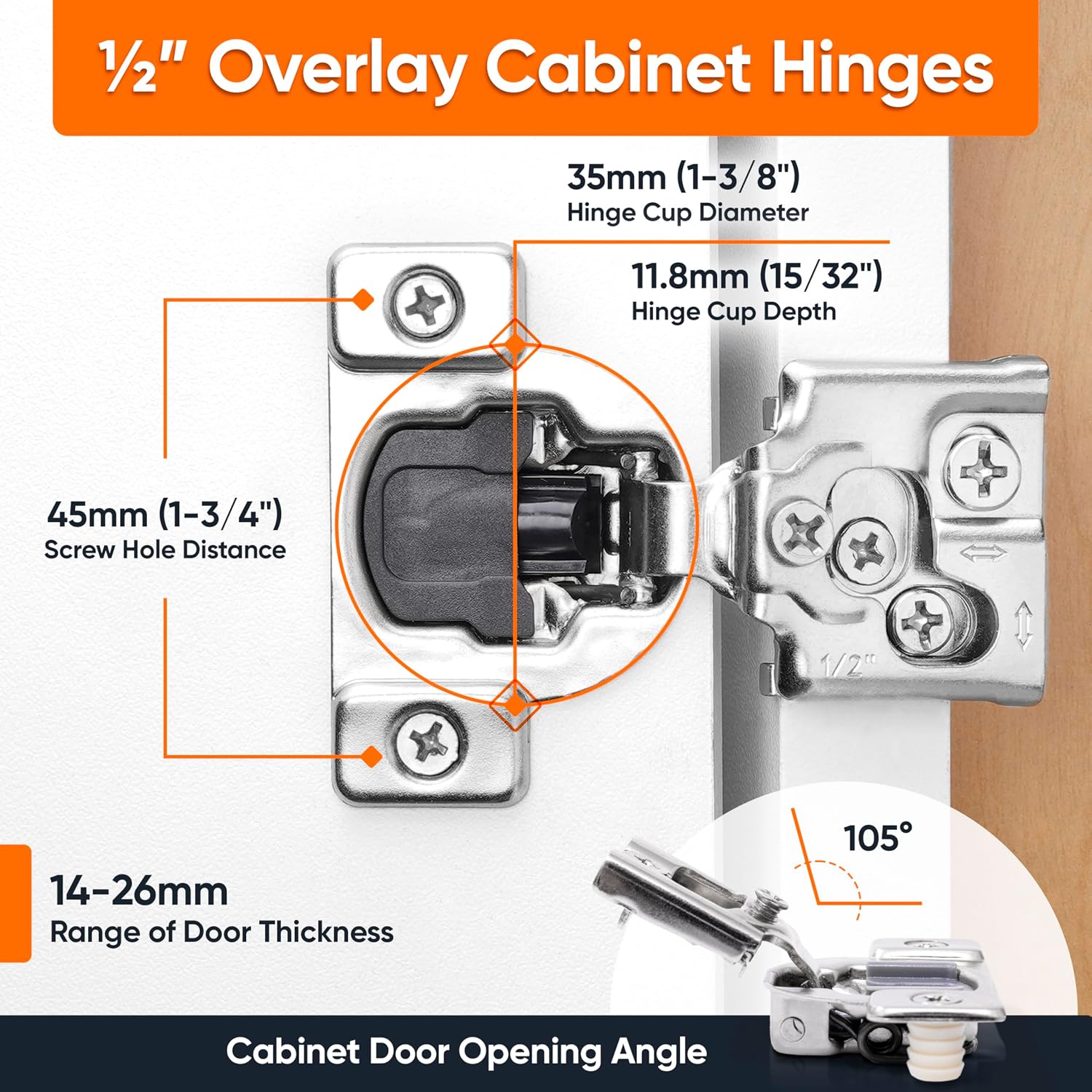
Decobasics
$53.99
In stock on Amazon
Check price on AmazonChibery: 4D Adjustment and What It Actually Buys You
Chibery is a mid-budget brand that has built a following specifically around its four-axis (4D) adjustment mechanism. Standard soft-close hinges adjust in three directions: up/down, left/right, and in/out (depth). A 4D hinge adds rotation — the ability to cant or twist the door slightly around its vertical axis. This matters when a door is hanging at a slight diagonal despite correct up/down and left/right alignment, which happens when cabinet boxes are out of square or face frames have minor warping.
Owners who report benefiting from 4D adjustment tend to be working with older cabinets where the boxes have racked slightly over time, or with new installs where the wall isn’t perfectly plumb. For a first install on factory-fresh RTA boxes, 3D adjustment is almost always sufficient.
The known installation nuance with Chibery: Multiple owner reviewers on Houzz note that the 4D adjustment screw — the additional rotational axis — is stiffer than expected and requires firm, deliberate turns rather than the light-touch micro-adjustments the other three screws allow. This is consistent enough across owner accounts to characterize as a design characteristic rather than a defect. Go slow, use a proper #2 Phillips bit, and don’t rush the fine-tune.
Critical compatibility warning: Chibery mounting clips and DecoBasics mounting clips are not interchangeable. If you’re mid-project and mixing brands across a kitchen, confirm that your clip plates match your hinges. Mixing Chibery hinges onto DecoBasics clip plates (or vice versa) produces an unreliable fit. Buy complete sets — hinge plus clip plate — from the same brand.
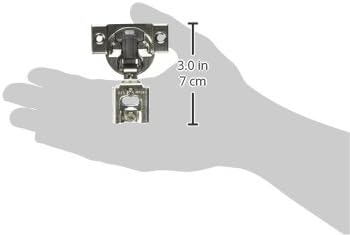
3/4"
$35.23
In stock on Amazon
Check price on AmazonDecoBasics: The Budget Workhorse With a Compatibility Caveat
DecoBasics positions itself at the accessible end of the market, and the owner consensus on Houzz is broadly positive for lighter-duty applications. Reviewers consistently rate the damping action as adequate for standard cabinet doors, and the 35mm cup hole sizing is consistent with European standards, meaning the hinges drop into any existing 35mm bore without modification.
As This Old House’s Cabinet Hinge Buying Guide notes, virtually all concealed cup hinges sold in the North American market since the 1990s use the 35mm standard — so if you’re replacing existing concealed hinges, no redrilling is required when switching to DecoBasics from another brand in the same format.
Where DecoBasics earns skepticism is in the heavy-door scenario. Reviewers who pushed DecoBasics on solid-wood doors above roughly 5–6 lbs report inconsistent damping, with some doors soft-closing reliably and others beginning to lose resistance over time. For a rental-grade flip or a budget bathroom vanity where the doors are lightweight and replacement cost is a primary concern, DecoBasics represents reasonable value. For a high-end kitchen with painted solid-wood shaker doors, the math favors paying for Blum.
The clip incompatibility with Chibery noted above is worth repeating as a standalone decision rule: do not order DecoBasics hinges to replace a partial set of Chibery hinges, or vice versa, without replacing the clip plates as well.
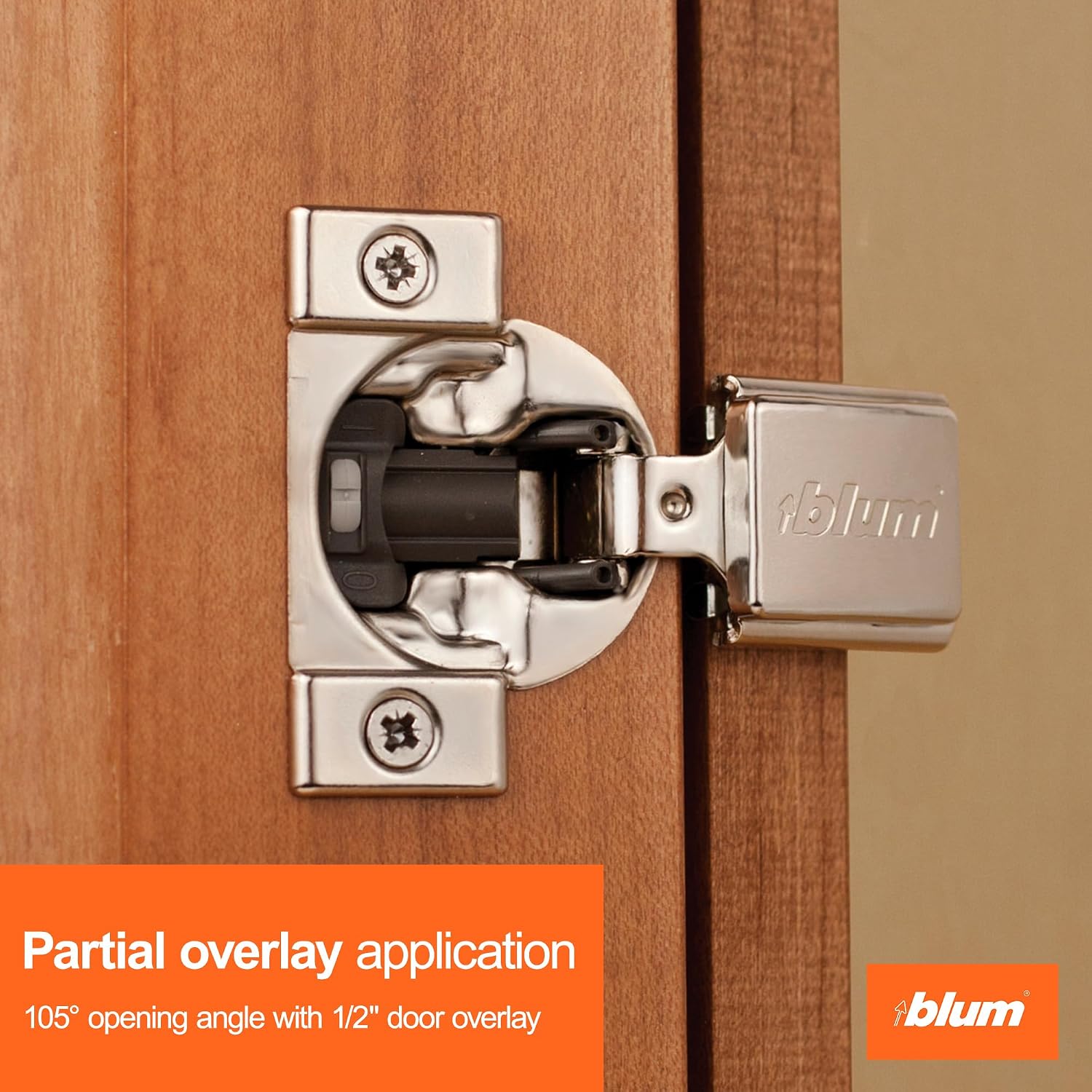
Blum
In stock on Amazon
Check price on AmazonBerta: The IKEA SEKTION Owner’s Upgrade
Berta has earned an unusually enthusiastic following among IKEA SEKTION owners. The NKBA Kitchen & Bath Market Index, 2025 annual report, continued to show IKEA among the top three cabinet brands by unit volume in the entry-level segment — which means a significant portion of the cabinet-buying population is living with IKEA’s stock hinges and wondering whether there’s something better.
The answer, based on what owners consistently report on Houzz through Q1 2026, is emphatically yes. One recurring reviewer sentiment — that Berta hinges are dramatically better than IKEA’s included hinges — reflects a real and consistent pattern. IKEA’s stock hinges are functional but their soft-close damping is light; owners on SEKTION installs with heavier custom doors or upgraded door panels (a common SEKTION customization) report that the IKEA hinges can’t keep up with the added weight.
Berta’s hinges use the same 35mm cup-hole sizing and frameless mounting geometry as SEKTION cabinets, and owners report a straightforward swap with no drilling required. The clip-on system is compatible with IKEA’s mounting plate configuration. For anyone running a SEKTION kitchen and wanting a genuine soft-close upgrade without touching the cabinet box, Berta is the answer the owner community keeps pointing to.
One note: Berta is a frameless/full-overlay specialist. If you’re working with traditional face-frame cabinets and need half-overlay, confirm the specific SKU before ordering.
3/4"
$35.23
In stock on Amazon
Check price on AmazonIf X, Then Y: Your Decision Framework
Here’s the honest summary after reading through the specs and owner reports:
-
If your doors are heavy (solid wood, glass panels, above ~6 lbs per door): Pay for Blum. The premium is real; so is the performance delta on heavy doors. This is the one scenario where the cheaper brands show a documented pattern of underperforming.
-
If your cabinets are out of square or you’re retrofitting older face-frame boxes with minor warping: Chibery’s 4D adjustment earns its place. Accept that the rotational screw is stiff — it’s not broken, just firm. Go slow.
-
If you’re on a budget and your doors are lightweight (thermofoil, thin MDF shaker, hollow-core): DecoBasics is a defensible choice. Just don’t mix clips with Chibery hardware, and don’t push it on heavy doors.
-
If you own IKEA SEKTION or BESTA cabinets: Berta is the clearest upgrade path the owner community points to, consistently and emphatically. The fitment is purpose-matched, the improvement over stock IKEA hinges is meaningful, and the install is a direct swap.
-
If you’re buying for a contractor-volume job across multiple kitchens: Blum’s CLIP top system’s tool-free door removal pays back in labor savings over a long install season. Price it against the labor delta, not just the hardware delta.
Frequently Asked Questions
How do I measure my overlay to know whether I need ½-inch or ¾-inch hinges? Close the cabinet door. Measure from the outer edge of the closed door to the outer edge of the face frame it overlaps. Close to ½ inch = full overlay. Close to ¾ inch = half overlay. On IKEA and most modern frameless cabinets, full overlay is standard. When in doubt, measure two or three doors and average them — face frames aren’t always perfectly consistent. Family Handyman’s hinge installation guidance recommends this same multi-door averaging approach to account for minor variation across a run of cabinets.
Will Blum hinges fit the same cup holes as my existing non-Blum hinges? Almost certainly yes. Blum’s CLIP top BLUMOTION uses the industry-standard 35mm cup hole, which is universal across European-style concealed hinges. The cup drops in identically. The only variable is the mounting plate (clip base): Blum’s clip plates are brand-specific, so you’ll replace those as part of the swap — but no redrilling of the door or cabinet is required.
Can I use face-frame hinges on IKEA SEKTION or BESTA cabinets? No. SEKTION and BESTA are frameless (full-overlay, European-style) cabinet boxes. Face-frame hinges are designed to mount onto a protruding wood frame that IKEA boxes don’t have. Use frameless full-overlay hinges — all four brands reviewed here offer compatible options in their full-overlay configurations.
What does four-axis (4D) adjustment actually let me fix that three-axis (3D) can’t? Standard 3D hinges adjust a door up/down, left/right, and in/out (depth from the frame). A 4D hinge adds rotational adjustment — you can cant the door slightly clockwise or counterclockwise around its vertical axis. This corrects a diagonal hang that persists even after you’ve dialed in the other three axes. It’s most useful on out-of-square cabinets or walls that aren’t perfectly plumb.
Can I turn off the soft-close feature on individual hinges if I want some doors to swing freely? On Blum’s CLIP top BLUMOTION, yes — per Blum Inc.’s CLIP top BLUMOTION product specification sheet (2024 edition), there is a built-in switching mechanism that allows you to deactivate the damper on individual hinges without removing them. On most budget-tier hinges including DecoBasics and Berta, this feature is not available; the soft-close action is fixed. Chibery’s 4D line varies by SKU — check the specific product spec before assuming this capability.
Do all these hinges require a 35mm cup hole, or do some need a different size? All four brands reviewed here — Blum, Chibery, DecoBasics, and Berta — use the industry-standard 35mm cup hole. This Old House’s Cabinet Hinge Buying Guide notes that this 35mm standard is universal across European concealed hinges and has been the North American norm since the 1990s. If you’re replacing existing concealed hinges, no redrilling is required regardless of which brand you choose from this group.