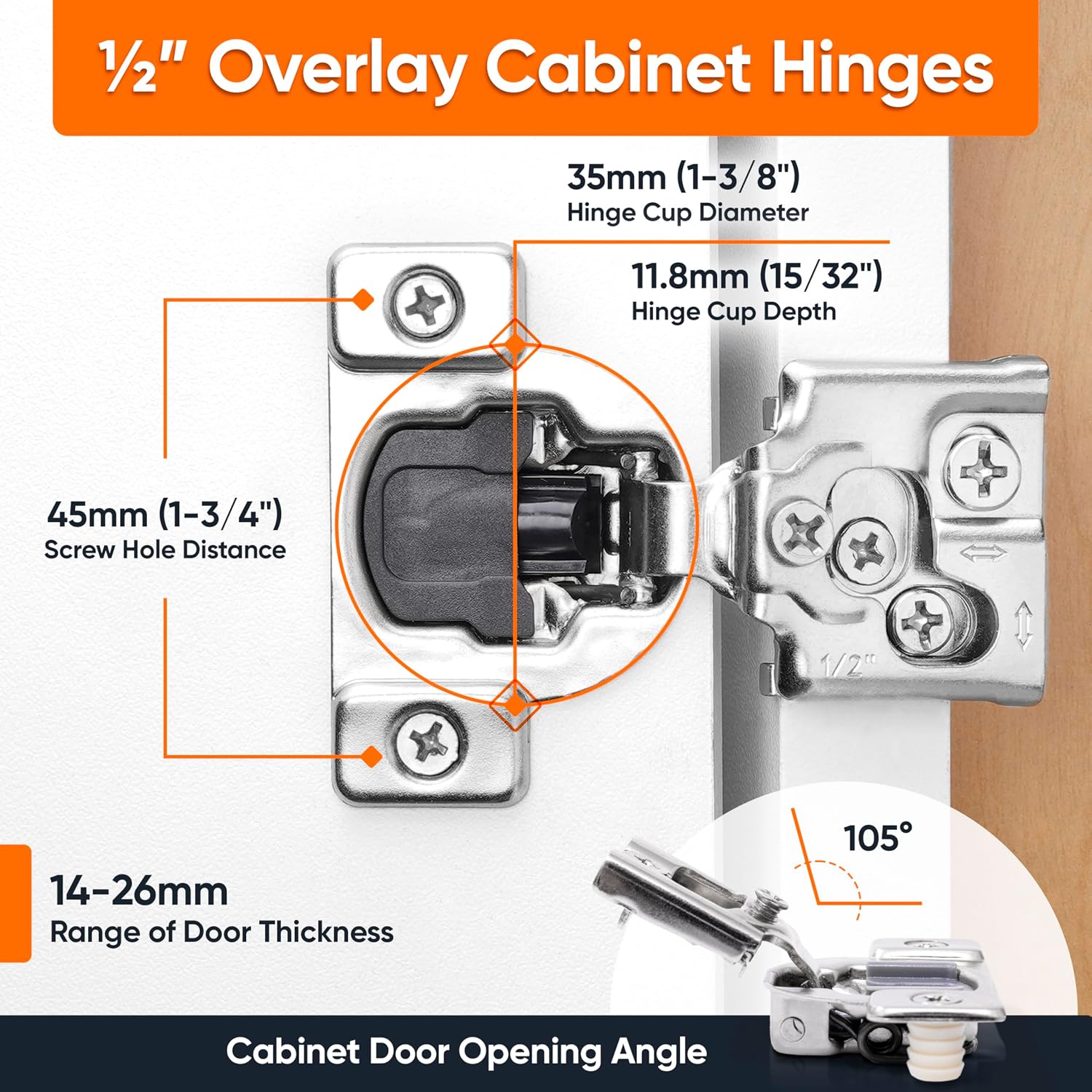
If you’ve never replaced a cabinet hinge before, here’s the short version: a soft-close hinge is the small metal mechanism inside your cabinet door that makes the door glide quietly shut instead of slamming. The “soft-close” part is a tiny hydraulic damper — either built into the hinge body itself or snapped on as a separate plastic clip — that slows the door in the last inch of travel. Getting the right hinge means matching three things: the style of your cabinet box (face frame or frameless), the amount of door that covers the cabinet opening (called the overlay), and the brand of hinge body you’re already using or plan to use. Get any one of those wrong and your doors either won’t close, will rub the frame, or will cost you a frustrating afternoon of do-overs. This guide walks through every variable so you can spec these correctly before anything ships to the jobsite.
| EDITOR'S PICKDecobasics 50 Pack Soft Close C… | Mid-tier3/4" Blum® Compact Soft-Close B… | Budget pickBlum Compact BLUMOTION Hinge (1… | |
|---|---|---|---|
| Pack size | 50 | 10 | 10 |
| Overlay | 1/2" | 3/4" | 1/2" |
| Steel type | Stainless steel | — | Steel |
| Adjustability | 3-way | — | — |
| Price | $53.99 | $35.23 | |
| See on Amazon → | See on Amazon → | See on Amazon → |
Face Frame vs. Frameless: This Is the First Fork in the Road
Before you think about overlay or brand, you need to know what kind of cabinet box you’re working with, because the hinge types are not interchangeable.
Face frame cabinets (dominant in North American kitchens, especially stock and semi-custom lines like Hampton Bay, Fabuwood, and most Kraftmaid) have a solid wood frame — typically ¾-inch thick — attached to the front of the plywood box. The hinge mounts to that frame. Because the frame adds thickness, the hinge cup (the round cutout in the door) has to be set at a specific angle — usually 0°, 30°, or 45° depending on overlay — to allow the door to swing clear of the frame.
Frameless cabinets (called European-style) have no face frame. The door mounts directly to the side wall of the box, which is typically ¾-inch thick. European hinges are designed for this: they clip directly to a mounting plate screwed into the interior side panel. IKEA SEKTION and Besta are the most common frameless systems most renovators encounter. Frameless hinges are nearly always 0° (straight), because there’s no frame to swing around.
This Old House’s cabinet hinge buying guide draws a clean distinction: face frame hinges require the hinge body to be angled to achieve proper door swing, while frameless/European hinges rely on the mounting plate’s position on the panel to set overlay. Mixing these up — dropping a face frame hinge on a frameless box — will get you a door that either physically can’t close or sits at the wrong angle relative to adjacent doors.
The fast check: Open a cabinet and look at the interior front corner. If you see a strip of wood framing the opening on the inside, it’s face frame. If the door mounts straight to the side panel with no frame visible, it’s frameless.
Overlay Sizes: What ½-Inch, ¾-Inch, and 1¼-Inch Actually Mean
Overlay describes how much the door overlaps the cabinet opening (or the face frame, on face frame cabinets). This is not a preference — it’s a measurement that must match the door size you have or are ordering.
| Overlay | Typical Application | Common Hinge Angle (Face Frame) |
|---|---|---|
| ½-inch | Inset-adjacent, older stock cabinets | 0° or 30° |
| ¾-inch | Most North American stock/semi-custom | 0° or 30° |
| 1¼-inch | Full overlay, modern shaker-style | 45° |
| Full overlay / zero reveal | Frameless European | 0° (mounting plate sets position) |
Family Handyman’s hinge installation guide emphasizes measuring the overlay after the door is hung with a temporary clip — because door sizing varies enough between manufacturers that trusting catalog specs alone leads to ordering errors. On a 10×10 kitchen with 20 doors, one wrong overlay size means 40 mismatched hinges and a reorder delay that can push an installation by a week.
Practical shortcut: On face frame cabinets, measure from the edge of the door to the edge of the face frame opening when the door is closed. That gap on each side is your reveal, and your overlay is the door width minus the opening width, divided by two. If your doors overlap the face frame by ¾ inch on each side, you need ¾-inch overlay hinges.
Brand Compatibility: The Trap That Catches Even Experienced Buyers
Here is the finding that costs people the most time and money, so it gets its own section.
Hinge bodies and soft-close clip plates are brand-matched systems. They are not universally interchangeable.
This is not a technicality — it’s a real problem that owners run into in the field. Reviewers of DecoBasics soft-close clips explicitly document that their clip plates did not physically fit onto Chibery hinge bodies, even though both products are sold as “standard” 35mm cup hinges. The clip’s locking tab geometry is proprietary enough that the snap-fit simply doesn’t engage on a competing body. The reviewer ended up sourcing a different clip entirely to make the installation work.
The practical implication: if you are replacing soft-close clips on existing hinge bodies — rather than replacing the entire hinge — you must either buy clips from the same brand as your hinge bodies, or replace the hinge bodies entirely. Mixing Chibery bodies with DecoBasics clips, or Berta clips with Chibery bodies, is a documented failure mode.
⚠ Callout: Screw-On vs. Clip-On Mounting Plates — A Separate Compatibility Trap Blum owners replacing hinges frequently run into this: Blum sells both clip-on mounting plates (which snap to a receiver base) and screw-on mounting plates (which mount directly to the panel with no receiver). If your existing installation used screw-on bases and you order clip-on hinges — or vice versa — the new hinge will not mount. Always confirm plate style before ordering replacement Blum hardware. This applies to any brand that offers both systems.
Houzz community threads on kitchen cabinet hardware document this confusion repeatedly, particularly among buyers who purchased cabinet boxes from one source and hardware from another. The safest workflow: identify your existing hinge brand and plate style first, then order within that system.
When Blum Is Worth the Premium (And When It Isn’t)
Blum is the benchmark that budget brands are measured against, and the price gap is real — Blum Blumotion hinges typically run 3–5× the per-hinge cost of brands like Chibery, DecoBasics, or Berta when purchased in the quantities a single kitchen requires.
Owners who documented genuine heavy-door installations — 30-inch-tall solid wood doors, doors with substantial glass inserts, or pantry doors over 24 inches wide — consistently report a pattern: budget soft-close mechanisms either fail to slow the door meaningfully, or the damper weakens within 6–18 months. One detailed owner account describes trying three separate budget brands on solid maple overlay doors before Blum finally produced the consistent soft-close action the project required. For those applications, the premium is functionally justified by the Blum mechanism’s rated load capacity and the durability of its hydraulic damper under repeated heavy use.
For standard ¾-inch MDF shaker doors in a typical 10×10 kitchen — the majority of residential installations — the case for Blum narrows considerably. Across aggregated reviews, owners of mid-weight doors using Chibery, Berta, and comparable 35mm cup hinges report satisfactory soft-close action with no damper failure in the 1–2 year window most reviews cover. The NKBA’s Kitchen & Bath Planning Guidelines note that door hardware should be specified to door weight and use frequency — a useful reminder that “best hinge” is a function of application, not an absolute ranking.
The honest decision rule: If your doors are solid wood, over 18 lbs, or see commercial-level open/close frequency, spend the money on Blum. For standard residential MDF or paint-grade shaker doors, the budget tier performs adequately and the savings on a 40-hinge kitchen run $150–$300 — real money that can go elsewhere in the project.
Chibery’s 4D Hinge: Genuine Differentiator With One Known Annoyance
Chibery’s 4D adjustable hinge offers four-directional adjustment — up/down, left/right, in/out, and closing speed — from a single hinge body. The closing speed adjustment is a genuine functional differentiator: you can tune the damper tension to match door weight without buying a different hinge. Reviewers consistently notice and appreciate this.
The honest caveat, reported directly by owners: the vertical adjustment screw is notably difficult to turn. Multiple reviewers describe needing a firm grip and patience to get meaningful vertical movement. It’s not a dealbreaker, but if you’re speccing 80 hinges on a large job and expecting quick field adjustment, factor in that the vertical axis will require more effort than the other three. For a one-time residential installation, it’s an inconvenience; for a contractor doing volume installs, it’s worth knowing before you commit.
Berta and IKEA Compatibility: A Specific Finding for a Large Audience
If you are renovating an IKEA SEKTION or Besta kitchen — a very common scenario given IKEA’s market penetration in the $80–$150/LF segment — you need IKEA-compatible hinges. IKEA uses a proprietary mounting plate system that differs from standard European clip-on plates.
Berta hinges have been specifically reviewed as IKEA SEKTION and Besta compatible by owners who replaced original IKEA hinges. The Berta mounting plates are designed to engage the same receiver bases IKEA pre-installs in their cabinet panels. This is a specific, verified-by-owners finding that matters: you do not have to replace IKEA’s mounting bases to upgrade to soft-close — Berta clips engage the existing bases directly.
This does not extend to all budget brands. Chibery and DecoBasics are not documented as IKEA-base compatible in the same way. If you’re working on an IKEA system, Berta is the name to research first.
Frequently Asked Questions
How do I know if I need a ½-inch, ¾-inch, or 1¼-inch overlay hinge? Measure how much your door overlaps the face frame (or cabinet opening edge) when closed. That overlap distance on one side is your overlay. Most stock North American cabinets use ¾-inch overlay; modern full-overlay shaker styles typically use 1¼-inch.
Are soft-close clip plates interchangeable between Chibery, DecoBasics, and Berta hinges? No. Clip plates are brand-matched systems. A DecoBasics clip documented as incompatible with Chibery hinge bodies by a verified reviewer — the locking tab geometry differs enough to prevent engagement. Buy clips from the same brand as your hinge bodies, or replace both together.
Do these hinges fit IKEA SEKTION or Besta cabinets? Berta hinges have owner-documented IKEA SEKTION and Besta compatibility. Chibery and DecoBasics are not confirmed as compatible with IKEA’s proprietary mounting bases. For IKEA systems, verify IKEA-base compatibility explicitly before ordering any third-party hinge.
How many hinges do I need per door, and should every hinge be soft-close? Standard practice per Family Handyman’s installation guide: two hinges for doors up to 40 inches tall, three hinges for doors 40–60 inches. For soft-close, you need only one damper clip per door — the second hinge can be a standard (non-soft-close) body. However, most buyers simply use soft-close bodies on all hinges for simplicity and resale perception.
What is the difference between a face frame hinge and a frameless European hinge? Face frame hinges are angled (0°, 30°, or 45°) to allow the door to swing around the solid wood frame at the front of the cabinet box. European/frameless hinges are straight-body hinges that mount directly to the interior side panel of a frameless box, with overlay determined by mounting plate position rather than hinge angle.
Is Blum worth the price premium over budget brands for a standard home kitchen? For standard residential doors in the 10–20 lb range, owner reviews suggest budget brands perform adequately within the 1–2 year review window most accounts cover. Blum’s premium is clearly justified for heavy solid-wood doors, high-frequency use, or commercial applications where damper longevity is critical. For a typical paint-grade shaker kitchen, the savings from budget-tier hinges are real and can be redirected to higher-impact line items.