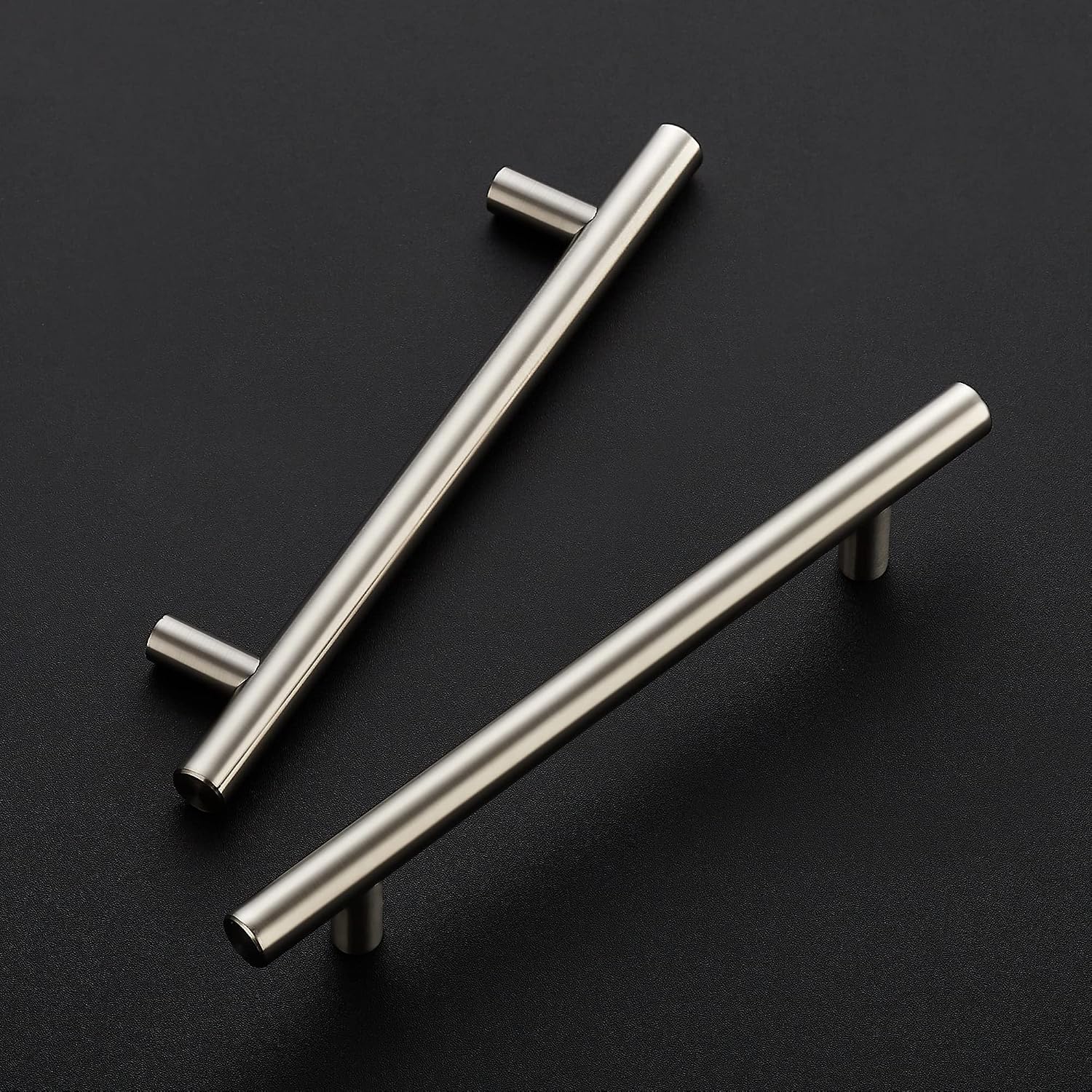
If you’ve ever stood in a hardware aisle holding two pulls that look nearly identical and cost $3 apart per piece — yet one is $90 over a full kitchen and the other is $270 — you already know this decision matters more than it first appears. A cabinet pull is the small bar or handle you grip to open a cabinet door or drawer (as opposed to a knob, which is a single-point grip). “Brushed nickel” describes a matte-silver finish that’s less shiny than polished chrome and less warm than satin brass — it hides fingerprints well and sits comfortably in both traditional and contemporary kitchens. What the finish label doesn’t tell you is what’s underneath it: the base metal, the plating thickness, and the coating that determines whether that pull looks great at year five or starts flaking by year two. This guide breaks down what the specs actually mean at three price tiers — budget, mid-range, and premium — so you can match the hardware to your project without overspending or under-specifying.
Why the Base Metal and Plating Process Change Everything
Here’s the tradeoff most buyers don’t see until it’s too late: the “brushed nickel” color is a surface treatment. What lives underneath that surface is the variable that drives longevity, weight feel, and long-term finish integrity.
Zinc alloy (zamak) is the most common base metal in budget-tier pulls. It’s a die-cast material that machines cleanly, holds detail well, and keeps manufacturing costs low. Per published spec comparisons covered by This Old House’s hardware guidance, zinc alloy pulls are entirely serviceable in low-humidity environments — a bedroom dresser, a laundry room cabinet — but they’re more vulnerable to corrosion in high-moisture zones (above a dishwasher, near a sink) because zinc is galvanically active when the plating thins or chips.
Solid brass is the preferred base metal from mid-range upward. Brass is dimensionally stable, corrosion-resistant, and doesn’t “telegraph” oxidation through the finish the way zinc does. Architectural Digest’s hardware comparison notes that solid brass pulls consistently earn higher long-term satisfaction scores in owner reviews precisely because the base metal stays inert even when surface wear begins. You’ll feel the difference in hand, too — a solid brass pull at 3/8-inch diameter has noticeably more heft than a zinc pull at the same visual size.
Stainless steel appears in a subset of premium-tier and commercial-adjacent pulls. It’s the most corrosion-resistant option and nearly immune to the humid cycling of a kitchen environment. The tradeoff is cost and machining complexity — stainless is harder to plate consistently — so it’s less common in decorative residential hardware than in commercial or bath-specific lines.
Plating thickness is measured in microns, and the industry spec sheets diverge sharply here. Budget pulls typically carry 0.1–0.3 microns of nickel plating. Mid-range pulls run 0.5–1.0 microns. Premium pulls — particularly those certified to ASME A112.18.1 or ANSI finish durability standards — often specify 1.5 microns or more with a PVD (physical vapor deposition) or lacquer topcoat that bonds the finish at a molecular level rather than just layering it on. Per Family Handyman’s installation spec notes, PVD-finished hardware is rated to outlast standard electroplated finishes by a factor of three to five in abrasion testing conditions documented by manufacturers.
The Three Budget Tiers, Side by Side
Tier 1: Budget ($1.50–$4.00 per pull)
At this price point, you’re almost always looking at zinc alloy base with electroplated brushed nickel. The finish is applied via standard nickel sulfamate or nickel sulfate bath — functional, but thin. Across aggregated Houzz reviews in kitchen remodel threads from 2023–2025, the consistent pattern for pulls in this tier is: finish holds well for 12–18 months under normal use, then shows wear at contact points (the center of the bar, the ends near the screw posts) by years two to three. In a flip or a rental context where you’re targeting a 2–4 year resale horizon, this is a mathematically acceptable tradeoff. In an owner-occupied kitchen you’re planning to live in for a decade, it isn’t.
The other limitation at this tier is bore spacing precision. Budget pulls are typically manufactured to ±1.5mm tolerance on the center-to-center hole spacing (the distance between the two mounting screws). That sounds small, but if you’re sourcing pulls for a 30-cabinet kitchen and your existing bore pattern is exactly 96mm, a ±1.5mm tolerance means some pulls fit cleanly and some require enlarged holes or wobble on installation. Family Handyman’s hardware installation guidance flags this as the most common source of callback complaints on budget hardware jobs.
Best fit: Rentals, flips targeting quick resale, secondary storage areas (laundry, garage, pantry), or staging installs where the hardware will be replaced by the end buyer.
Tier 2: Mid-Range ($5.00–$12.00 per pull)
This is where the spec sheet meaningfully changes. Mid-range pulls — think established lines from Amerock, Liberty Hardware, or Hickory Hardware’s mid-catalog — typically move to solid brass or zinc alloy with substantially thicker plating (0.5–1.0 microns) and often add a clear lacquer or e-coating topcoat that seals the finish against humidity cycling.
Apartment Therapy’s hardware buyer’s guide notes that owner-reported satisfaction at this tier trends significantly higher at the 3-year mark compared to budget pulls — the finish holds, the weight feels intentional, and the manufacturing tolerances tighten to ±0.5mm, which matters when you’re doing a full kitchen in one order. At this tier you also start seeing options for longer center-to-center spacings (128mm, 160mm, 192mm) that align with drawer-front proportions on 24-inch and 30-inch drawers — a detail that matters aesthetically on a design-forward project.
The cost math on a representative 10×10 kitchen (roughly 40–50 pulls and knobs depending on door/drawer count):
By the numbers
- Tier 1 at $3.00 avg: ~$135–$150 hardware total
- Tier 2 at $8.00 avg: ~$360–$400 hardware total
- Tier 3 at $18.00 avg: ~$810–$900 hardware total
- Delta from Tier 1 → Tier 2: ~$220 per kitchen
That $220 delta buys you a base metal upgrade, a finish that owners consistently report still looking clean at 3–5 years, and tolerances that reduce your install time. For a contractor running multiple kitchens, the install-time savings alone can recover the hardware premium inside a single job.
Best fit: Owner-occupied kitchens with a 5–10 year horizon, mid-range renovation packages, semi-custom cabinet projects where the hardware needs to visually match the cabinet quality without inflating the budget.
Tier 3: Premium ($14.00–$35.00+ per pull)
Premium pulls — lines like Top Knobs, Emtek, Schaub, and the upper tiers of Baldwin Hardware — are almost universally solid brass or solid stainless, with PVD or multi-stage electroplate finishes rated in manufacturer spec sheets at 1.5+ microns. Architectural Digest’s finish comparison notes that PVD brushed nickel in particular is meaningfully different from standard plated brushed nickel: the finish is harder (7–8 on the Mohs scale versus 3–4 for standard nickel plate), resistant to household acids and cleaners, and maintains its matte texture under heavy daily use.
The design vocabulary also expands. Premium hardware lines offer more nuanced interpretations of “brushed nickel” — warmer, cooler, finer-brushed, coarser-brushed — because the PVD process allows tighter control over the final color tone. If you’re specifying hardware to coordinate with a Dura Supreme or Fabuwood finish system, this level of control matters: a cool brushed nickel against a warm white cabinet can look off in ways that are difficult to undo.
Owner reviews aggregated from Houzz kitchen threads consistently report premium brushed nickel pulls looking “essentially the same as day one” at the 5–7 year mark, with the primary complaints being about price — not performance. At $18–$25 per pull for a 45-piece kitchen order, you’re at $810–$1,125 in hardware alone, and that’s before knobs for upper doors.
Best fit: Full kitchen commissions where hardware is part of the design specification, high-end rental or short-term rental properties where durability reduces turnover cost, projects where the cabinet investment ($12,000+) makes $300 in hardware upgrade a rounding error on the overall budget.
The Spec Details That Don’t Make the Marketing Sheet
A few variables that experienced buyers check but that rarely appear in product listings:
Screw gauge and thread quality. Budget pulls ship with #8-32 machine screws that are adequate for standard ¾-inch cabinet face frames. Mid-range and premium pulls often include longer screw options (1-inch, 1¼-inch) for thicker drawer fronts and solid-wood face frames — a detail that matters on frameless European-style boxes where the drawer front is the only mounting surface. Per Family Handyman’s installation guidance, mismatched screw length is the second most common hardware callback issue after bore spacing.
Post diameter. A 5/16-inch post diameter is standard; some budget pulls thin down to ¼-inch to save material. On a high-traffic drawer that gets pulled open 20+ times a day, the thinner post is a long-term fatigue risk — owners in Houzz reviews of budget hardware occasionally report bent or cracked posts at the screw entry point after 2–3 years of heavy use.
Finish consistency within a batch. This Old House’s hardware guidance flags batch-to-batch color variance as a real issue with electroplated finishes. If you’re ordering mid-project to add pulls to a pantry cabinet or supplement an original order, standard electroplate can come in slightly different when the bath chemistry has shifted. PVD finishes hold tighter batch-to-batch consistency because the process is more tightly controlled — one more reason the premium tier earns its price on large or multi-phase projects.
The Decision Rule
If you’re reading the specs on a current project, here’s the clean frame:
- If the project is a flip, rental, or staging install with a sub-3-year resale horizon → Tier 1 is the right call. Spend the savings elsewhere.
- If the project is an owner-occupied kitchen, a semi-custom build, or a contractor package where your brand reputation rides on the long-term result → Tier 2 is the floor. The $200–$250 premium per kitchen is recoverable in reduced callbacks and stronger word-of-mouth.
- If the project carries a design specification, high cabinet investment ($10,000+), or a client who will notice hardware quality at year five → Tier 3 is worth pricing in from the start. The finish durability data and owner review pattern both support it.
The “brushed nickel” label is the starting point, not the answer. What’s under the finish — and how thick it’s been applied — is where the real spec comparison lives.