
If you’ve ever stood in a hardware aisle — or scrolled a product page at 11 p.m. — holding two pulls side by side and thinking they look almost the same but somehow completely different, you’re not imagining things. Cabinet hardware is one of those details that quietly sets the personality of an entire kitchen. A cup pull (sometimes called a bin pull or half-moon pull) is a curved, scoop-shaped piece of metal that you grip by curling your fingers underneath it. A bar pull is exactly what it sounds like: a straight or gently contoured rod mounted on two posts. Both do the same mechanical job — open a drawer or door — but they read differently in a space, they install differently, and they suit different cabinet styles. This article breaks down exactly how to choose between them, with honest notes on finish quality, construction tradeoffs, and the logistical details (screw lengths, batch ordering) that experienced buyers flag as the things nobody warned them about.
How Each Shape Reads in a Space
Shape is a design signal before it’s a functional choice. Understanding what each pull communicates helps you commit faster and second-guess yourself less during install.
Cup Pulls: Warmth With a Vintage Undercurrent
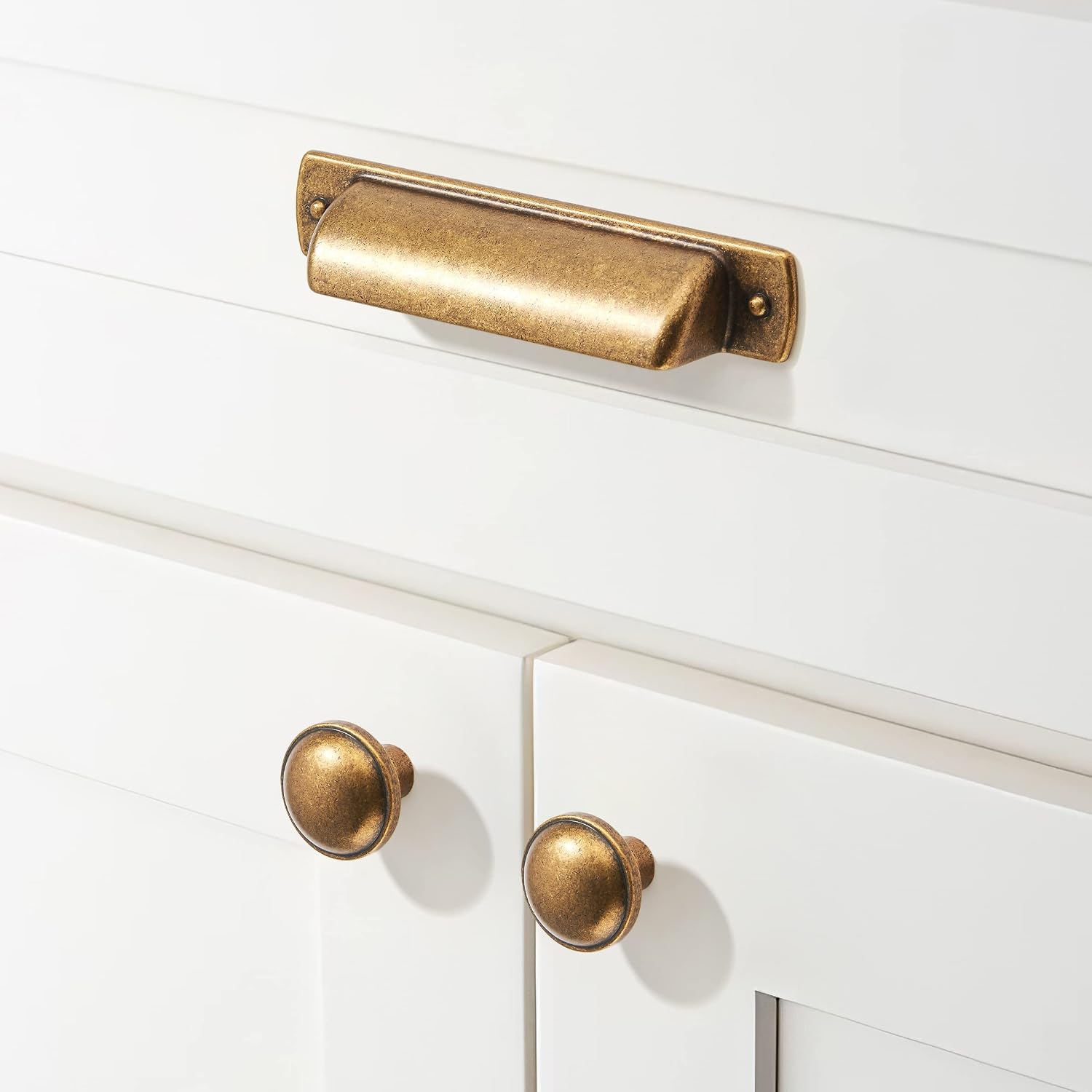
Cup pulls carry a vintage undercurrent even when they’re finished in a thoroughly modern metal. The curved form originated in industrial storage furniture — think old pharmacy cabinets and general-store drawers — and that heritage still reads. When you put champagne bronze cup pulls on flat-front Shaker drawers, the result consistently reads as warm and modern without being flashy. That distinction matters. Buyers who have been burned by hardware that looked warm in a photo and arrived looking yellow and brassy are specifically relieved by how champagne bronze cup pulls from Ravinte and comparable mid-range brands actually read on a cabinet face: gold in tone, not in attitude. Owner-reported descriptions across Houzz reviews for this finish category consistently land on phrases like “gold without being bright and brassy” — exactly the quality that makes them work alongside white, greige, or navy cabinetry without competing with the room.
One honest note from Houzz owner reviews on flat black cup pulls installed on IKEA SEKTION frames: buyers who chose this combination specifically to elevate a budget build consistently report that the hardware reads as custom. The flat black finish bridges the budget-frame gap in a way that brushed nickel bar pulls at the same price point don’t always accomplish. That’s a real signal if you’re managing a flip or a rental renovation where the goal is high-perceived-value at a controlled cost.
 product image](/images/external/175496ffc34b.jpg)
Probrico
$11.89
In stock on Amazon
Check price on AmazonBar Pulls: The Default of Contemporary Design
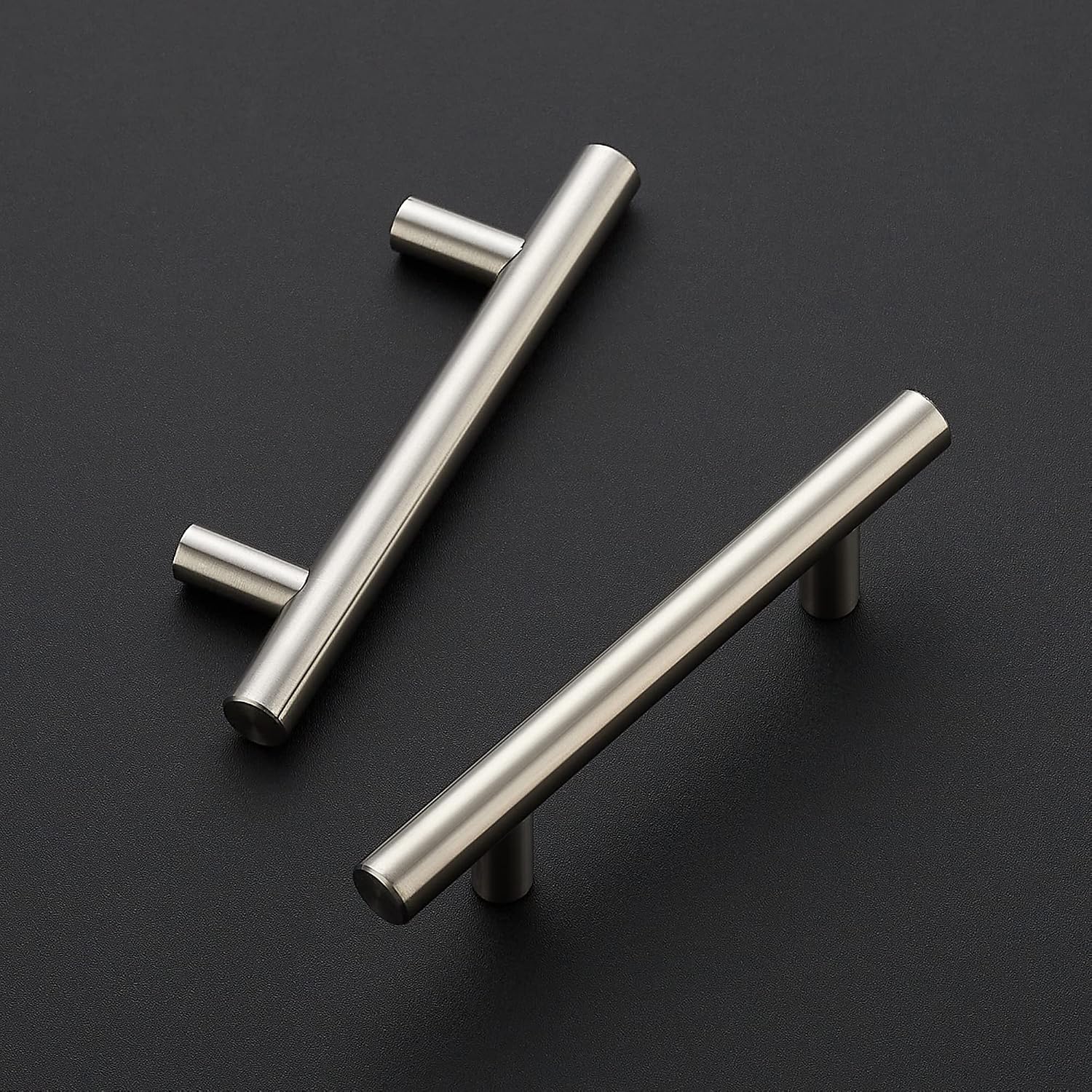
Bar pulls are the default of contemporary kitchen design for a reason. The clean horizontal or vertical line aligns with frameless European-style cabinetry, full-overlay doors, and any flat-front design language that values restraint. They’re easier to source in longer lengths for wide drawers, and they’re symmetrical in a way that reads orderly when repeated across 30 or 40 cabinet faces. This Old House, in its published guidance “How to Choose Cabinet Hardware,” notes that pull length should scale proportionally to drawer width — a convention that bar pulls satisfy more predictably than cup pulls across a wide range of drawer sizes.
The tradeoff is that bar pulls can feel anonymous on a kitchen that’s trying to have some personality. At a spec level, Architectural Digest’s 2025 feature “Cabinet Hardware Trends Worth Knowing” identifies the shift toward mixed-metal and mixed-shape hardware schemes as a direct response to exactly this limitation — homeowners who want a contemporary base but are layering in warmth through hardware shape rather than finish alone.
Ravinte
$13.18
In stock on Amazon
Check price on AmazonPremium and Mixed-Shape Installations
Done with intention, mixing cup and bar pulls often looks better than using one shape throughout — and this is where a more considered hardware budget pays off. Apartment Therapy’s editorial feature “The Case for Mixing Cabinet Hardware Styles” outlines the conventional approach: one shape on drawers, the other on doors, with the finish held identical across both. The eye reads the finish as the unifying element and accepts the shape variation as purposeful rather than inconsistent.
The National Kitchen and Bath Association (NKBA), in its hardware placement guidelines and ergonomic reach standards, treats drawer pulls and door pulls as functionally distinct surfaces — a framework that supports the mixed-shape approach from an ergonomic standpoint, not just a visual one. Cup pulls on drawers offer a natural curl-under grip suited to the downward pull of opening a drawer; bar pulls on upper doors suit the outward pull of a wall cabinet door. The ergonomic logic matches the visual logic.
Finish matching across shapes requires discipline. Buying cup pulls and bar pulls from the same brand in the same finish SKU is reliable. Cross-brand matching — even when the color name is identical — is not. “Brushed nickel” varies across manufacturers. Champagne bronze is a finish where the warm undertone results from a specific plating process, and the variation between brands is more visible in this finish than in flat black, which is more forgiving of tonal differences.
Scale matters as well. A 3-inch cup pull on a standard drawer paired with a 5-inch bar pull on a wide door creates a proportional relationship that reads intentional. Mismatched sizes — a 4-inch cup pull next to a 4-inch bar pull — can look like a mistake rather than a choice. This Old House’s hardware sizing guidance specifically addresses the relationship between pull center-to-center spacing and drawer face width as a proportioning rule that applies equally to mixed-shape schemes.
khtumeware
$20.79
In stock on Amazon
Check price on AmazonConstruction Honesty: What “Hollow” Actually Means for Bar Pulls
Here is the tradeoff that experienced buyers find out mid-project if nobody tells them upfront: most mid-range bar pulls — including popular options from Probrico, homdiy, and Ravinte’s brushed nickel line — are hollow. Not hollow like a cheap toy, but hollow like a structural tube: a formed zinc alloy or steel shell with the correct wall thickness to handle daily cabinet use, but noticeably lighter than a solid chrome pull if you pick one up and compare.
Reviewers who flag this detail — and many do, because the weight is perceptible in hand — still give high marks and specifically note that the visual result is indistinguishable after install. That is the key word: after install. Once a bar pull is mounted flush against a cabinet face, nobody is lifting it to assess gram weight. What they see is the finish and the profile. Across Houzz owner reviews, the pattern is consistent: the finish reads as high-quality at normal viewing distances, and owners do not report functional failures from hollow construction under typical residential use.
Where this becomes a real consideration:
- High-traffic commercial kitchens or rental properties with aggressive use cycles: in those contexts, heavier solid brass or stainless pulls may be worth the cost premium.
- Resale conversations with buyers who will open cabinets during showing: if a buyer picks up a bar pull and registers “lightweight,” it can trigger a quality concern even if it is unfounded. Cup pulls tend to feel more substantial in hand because the curved form distributes contact area differently.
For the vast majority of owner-occupied renovations and standard flips, buyers who know the construction reality — and they are usually the ones who have installed 60-plus pulls on a single project — report that it simply does not matter in practice.
The Screw-Length Detail Nobody Warns You About
Cabinet hardware comes with screws, and the screw situation is one of those unsexy logistics problems that becomes a real time cost if you are not prepared.
Most quality pulls — Ravinte and Probrico options earn consistent praise for this — include two screw lengths in the pack. This matters because cabinet door and drawer face thicknesses vary: IKEA SEKTION doors are a different depth than a solid wood face-frame door, and frameless European boxes differ again. Having both a short and a long screw in the pack means you can select the right length on-site without a separate hardware run.
Screw Length by Cabinet Type
| Cabinet Type | Typical Face Thickness | Screw to Use |
|---|---|---|
| IKEA SEKTION door | ~¾ inch | Short screw (typically 1”) |
| Solid wood face-frame door | ~¾–1 inch | Short or long depending on overlay |
| Drawer front (added to box front) | 1–1.5 inches total | Long screw (typically 1.5”–2”) |
The correct method for dealing with screws that are slightly too long is to trim them with wire cutters, not a rotary tool. Multiple experienced installers in Houzz review threads specifically call this out: a rotary tool or angle grinder can strip the thread end in a way that makes the screw harder to start. Wire cutters give a clean cut that threads cleanly into the pilot hole.
Frequently Asked Questions
Is the hollow construction of bar pulls a durability problem for daily kitchen use?
Based on aggregated Houzz owner reviews across multiple brands, hollow bar pulls hold up reliably under normal residential use. The functional failure point for cabinet hardware is almost always the mount — stripped pilot holes or loose screws — not the pull body itself. Reviewers who specifically note the hollow construction report no durability issues over multi-year ownership. If you are outfitting a commercial kitchen or a high-turnover rental, solid brass or stainless is worth the cost premium; for standard residential use, hollow construction is a non-issue after install.
Will champagne bronze cup pulls match my Delta or Moen champagne bronze faucet?
Finish names are not standardized across manufacturers, and champagne bronze is a finish where the warm undertone can vary noticeably. The safest move is to order a single pull before committing to a full run and compare it against your faucet in your kitchen’s actual light. Bathroom and kitchen lighting varies enough that a match that works in one room may read slightly different in another.
Can I mix cup pulls on drawers and bar pulls on doors with the same finish?
Yes, and this is a well-documented design approach. Apartment Therapy’s editorial feature “The Case for Mixing Cabinet Hardware Styles” covers this in detail, and the NKBA’s hardware placement guidelines treat drawer and door hardware as independently specified surfaces. Keep the finish identical — ideally same brand, same finish SKU — and the mix reads as deliberate rather than inconsistent.
Should I order all my hardware at once or can I reorder later?
Order everything in a single batch. Finishes — especially champagne bronze and brushed nickel — can vary slightly across production runs even from the same manufacturer. The variation is subtle but visible when hardware from different batches sits on adjacent doors. Over-order by 10–15% on a large project and keep the extras. Most pulls are sold in packs of 10 or 25; the cost of a buffer pack is trivial against the risk of a visible finish mismatch when a reorder lands in a different dye lot.
The Decision Rule
If you are still sitting with an open spec sheet and a pending hardware order, here is the honest framework:
- If your cabinetry is flat-front, frameless, or contemporary: default to bar pulls. The geometry is native to that design language, the finish options are widest, and the visual result is the most predictable.
- If your cabinetry is Shaker-style, face-frame, or you want warmth without going traditional: cup pulls are the right call, especially in champagne bronze or flat black. The curved form adds character that bar pulls cannot deliver at the same price point.
- If you are doing an IKEA SEKTION build and want it to read as custom: flat black cup pulls are the specific combination that owners in that situation consistently call out as the most effective upgrade per dollar spent.
- If you are managing finish matching across faucets and hardware: order a single sample pull before committing, compare it in your actual space, then order the full run in one batch.
Hardware is the last decision and the most visible one. Get the shape right for your cabinet style, confirm the finish in real light, and order everything at once. That is the whole playbook.