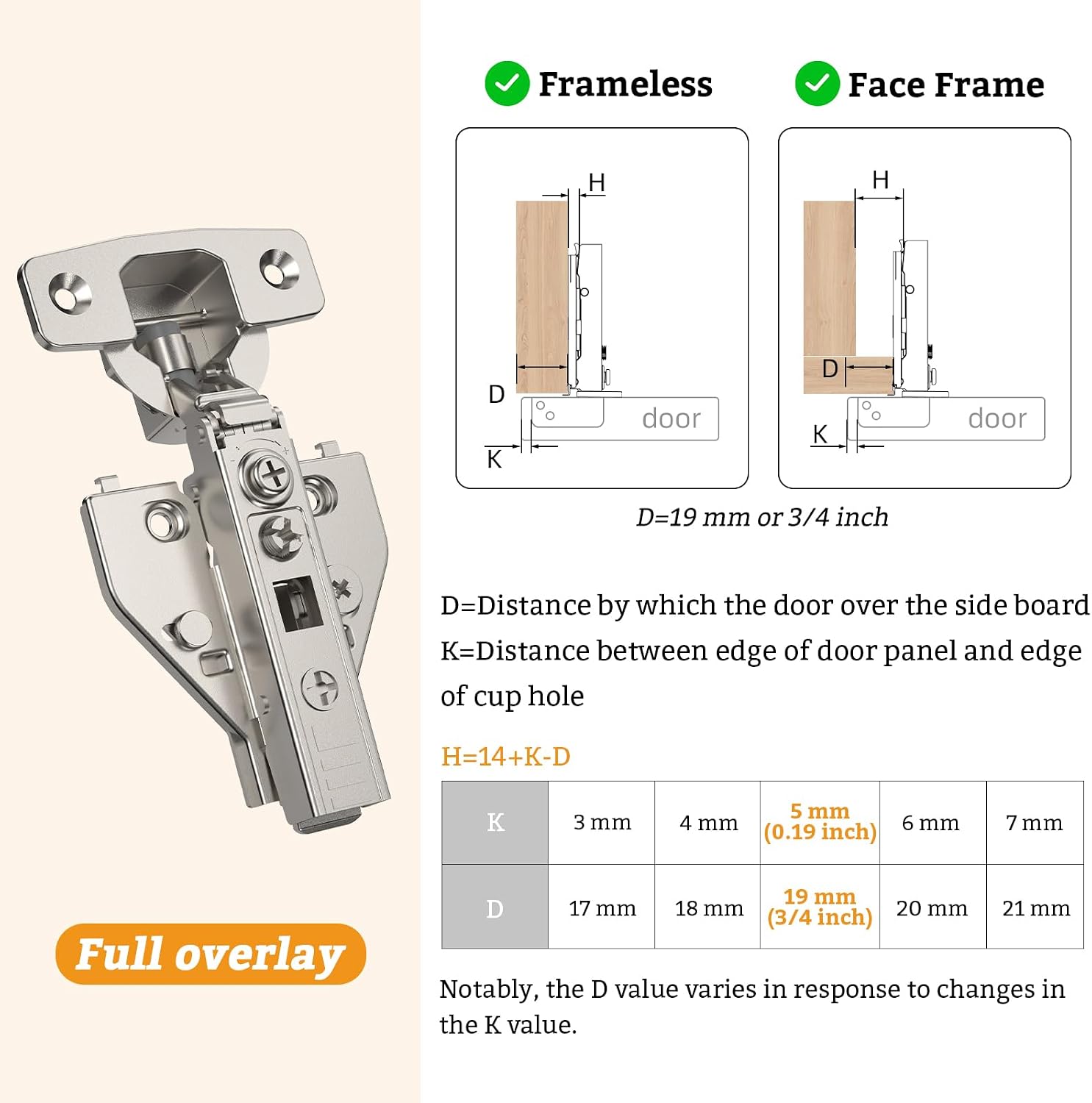
If you’ve ever ordered cabinet hardware and ended up staring at a hinge that simply will not mount flush — or worse, discovered the mismatch only after drilling — you already know the problem this article addresses. Cabinet boxes come in two fundamentally different constructions: face frame (where a solid wood frame is attached to the front of the box, framing the door opening) and frameless, also called full-access or European-style (where the box sides are the finished edge and the door overlays the box directly, with no frame in between). The hinges for each system are not interchangeable. Ordering the wrong type means the door either won’t close properly, the cup won’t seat, or your overlay math will be completely off. This article walks you through how to identify which construction you’re working with, what hinge specs actually mean in plain English, and which decision rules to apply before you place an order.
| EDITOR'S PICKChibery 50 Pack 1/2" Overlay 3D… | Mid-tier[Berta 10-Pack Full Overlay Fram…](https://www.amazon.com/dp/B073XWV34N?tag=greenflower20-20) | Budget pickChibery 2 Pack 1/2" Overlay 4D… | |
|---|---|---|---|
| Cabinet type | Face frame | Frameless | Face frame |
| Overlay | 1/2" | Full | 1/2" |
| Open angle | 105° | 110° | 105° |
| Dimensions adjust | 3D | 3D | 4D |
| Screws included | — | ✓ | — |
| Price | $45.89 | $22.55 | $7.64 |
| See on Amazon → | See on Amazon → | See on Amazon → |
Why the Construction Type Changes Everything About Hinge Geometry
The core issue is overlay geometry — how far the door extends over (or into) the cabinet opening. Face frame and frameless boxes have different reference surfaces, and hinge manufacturers engineer their products around one or the other.
In a face frame cabinet, the door has three overlay options relative to the face frame itself:
- Full overlay — the door covers almost the entire face frame, leaving a small reveal.
- Half overlay (also called partial overlay) — two doors share one frame stile; each covers roughly half of it.
- Inset — the door sits flush inside the frame opening, the most exacting fit.
The hinge for a face frame application has to account for the thickness of that frame (typically ¾ inch) sticking out in front of the box side. Hinge manufacturers achieve this with a mounting plate — sometimes called a baseplate — that has a built-in offset, or with a dedicated face frame adapter. Blum’s published specification sheets for their CLIP top line list specific mounting plates (B-style and T-style plates) that add different amounts of setback to accommodate face frame thickness and overlay depth simultaneously.
In a frameless cabinet, the door overlays the box side directly. There is no frame to account for. The hinge cup mounts in the door, and the mounting plate attaches directly to the interior side panel. Because the reference surface is the raw box side, full overlay on a frameless cabinet means the door edge is typically only 1/16 to 3/16 inch from the adjacent door or drawer front. Häfele’s technical bulletin on cabinet hinge selection notes that standard European (frameless) full-overlay hinges are designed for a door-edge-to-panel setback of roughly 37mm from the cup centerline — a spec that does not translate to a face frame box without the correct adapter.
The practical risk: If you order standard European frameless hinges and try to install them on a face frame box, the door will sit too far back or bind on the frame. If you order face frame hinges with a thick adapter and install them on a frameless box, you’ll get excessive gap between doors and the overlay won’t align. Houzz community discussion threads from 2023–2025 identify this as one of the most common hardware complaints from first-time renovators — and in nearly every case, the root cause was ordering hinges before confirming construction type.
Reading the Spec Sheet: Four Numbers That Actually Matter
Once you know your cabinet construction type, hinge selection narrows to four variables. Here’s how to decode them.
1. Cup Diameter
Nearly all modern concealed cup hinges — face frame or frameless — use a 35mm cup. Family Handyman’s published installation guide for European cabinet hinges describes this as the industry standard across Hettich, Blum, and Häfele product lines. Some older American-made face frame cabinets used a 26mm cup, so if you’re renovating rather than replacing from scratch, measure the existing bore before assuming 35mm.
2. Overlay
Overlay is expressed in millimeters or fractions of an inch and tells you how much of the cabinet side or face frame the door covers. Common overlay increments:
- Full overlay, frameless: typically 11/16” to 13/16” (17–21mm)
- Half overlay, face frame: typically 3/8” (the door covers one-half of a ¾” stile)
- Inset, face frame: 0mm overlay; the door sits flush
Blum’s CLIP top documentation lists overlay adjustability of ± a few millimeters through the hinge’s three-dimensional adjustment screws — but that range is a fine-tuning mechanism, not a substitute for selecting the right base overlay to begin with.
3. Opening Angle
Standard hinges open to 95–110 degrees. Wide-angle hinges (165–170 degrees) are available for corner cabinets or appliance garages where full door clearance matters. The National Kitchen and Bath Association’s Kitchen and Bath Planning Guidelines and Access Standards (2021 edition) note that accessible design often calls for 170-degree opening in ADA-compliant kitchen layouts. If you’re spec’ing a project with accessibility requirements, verify opening angle on every hinge, not just corner units.
4. Mounting Plate Type
This is the spec most often overlooked. For face frame applications, the mounting plate needs an offset to clear the frame thickness. Blum designates these as B-type or T-type plates depending on whether they’re for wood screw mounting or integrated clip systems. Häfele’s cabinet hinge selection guide categorizes plates by the frame protrusion they are designed to bridge. For frameless direct mount, plates are flat or carry minimal offset.
Quick-reference table:
| Construction | Typical Overlay | Cup Size | Plate Type |
|---|---|---|---|
| Frameless, full overlay | 11/16”–13/16” (17–21mm) | 35mm | Direct mount, flat plate |
| Face frame, full overlay | 1/2”–9/16” over frame | 35mm | Face frame adapter plate |
| Face frame, half overlay | 3/8” over frame stile | 35mm | Face frame adapter plate |
| Face frame, inset | 0mm | 35mm | Inset clip or wrap hinge |
Comparing Hinge Tiers: Budget, Mid-Range, and Premium
Not every project justifies the same hardware investment. The three tiers below map to realistic project types and budget constraints, with clear trade-offs at each level.
Budget-Tier Hinges: Add-On Dampeners, Entry-Level Brands
Entry-level concealed hinges from brands such as Amerock and similar import lines use the same 35mm cup standard and are available with clip-on soft-close dampeners rather than integrated mechanisms. The dampeners are small plastic units that attach to the mounting plate and cushion the door on closing.
The trade-off is durability. Houzz owner discussions over 2023–2025 consistently note that add-on dampeners tend to fall off on frequently used doors or degrade noticeably within two to three years. For a rental-grade renovation, a house flip, or a laundry room where traffic is low, this tier is cost-appropriate. For a primary kitchen used daily, the incremental savings rarely hold up over a five-year horizon.
This tier is also appropriate when you’re replacing a small number of hinges on an existing run and matching the existing plate geometry matters more than upgrading mechanism quality.
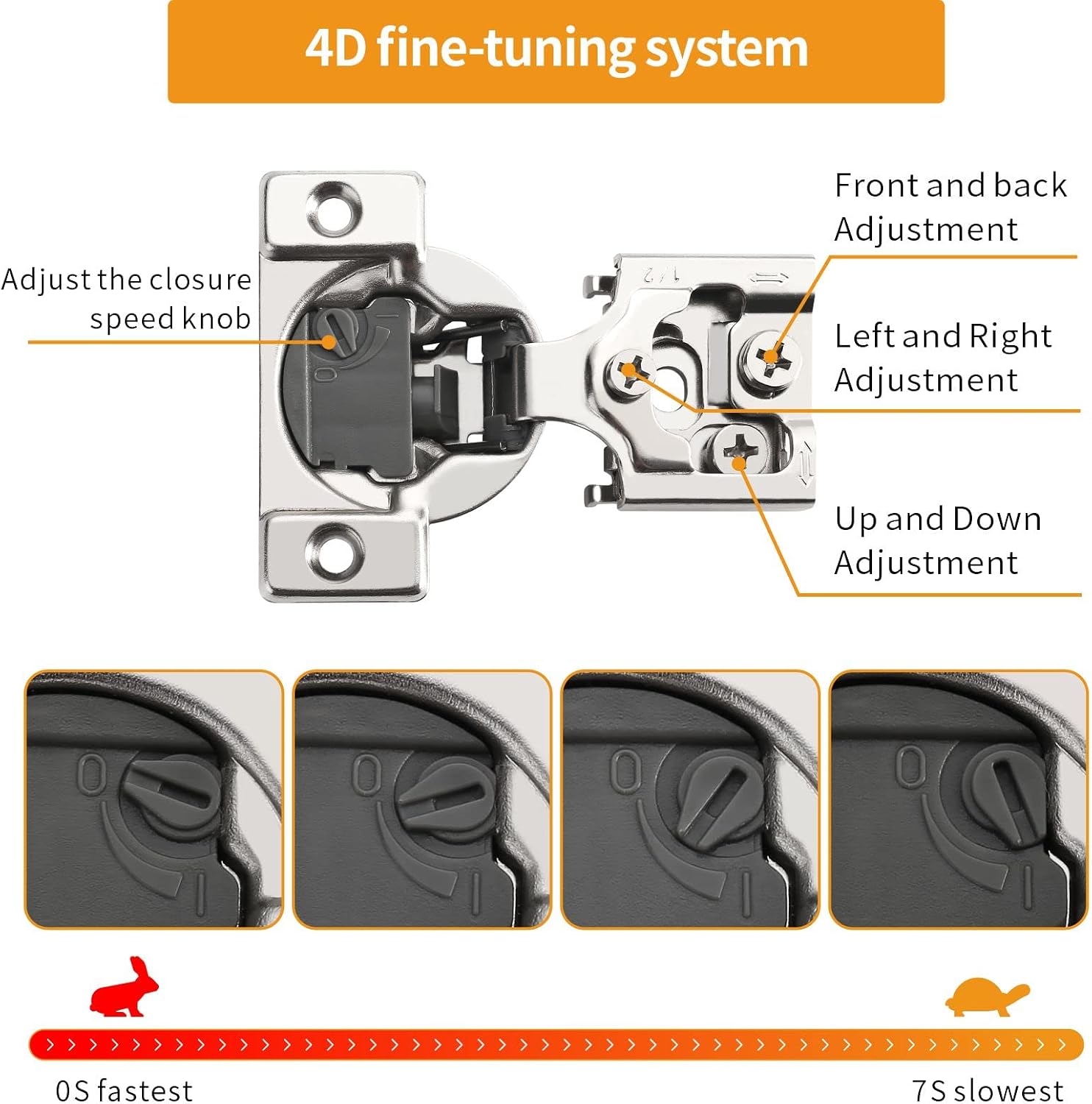
Chibery
$7.64
In stock on Amazon
Check price on AmazonMid-Tier Hinges: Integrated Soft-Close, Proven Platforms
Mid-tier hinges — Grass TIOMOS, Häfele Metalla, and comparable lines — combine integrated soft-close dampening with the 35mm cup standard and a full range of mounting plates covering both face frame and frameless applications. Integrated soft-close means the dampener is built into the hinge body rather than clipped on externally, so there is nothing to lose or replace.
This Old House’s cabinet buying guide identifies integrated soft-close as a durability indicator when evaluating mid-range and semi-custom cabinet lines, noting it as a construction detail that separates brands competing on specification rather than price alone. At contractor volume, mid-tier hinges with integrated soft-close typically run $4–$7 per hinge (spring 2026 distributor pricing per published sheets), making them accessible for full kitchen runs without significant budget pressure.
Häfele’s technical bulletin notes that the Metalla line uses the same 35mm cup and similar plate geometry to Blum CLIP top, making it a viable cost alternative where Blum pricing is a constraint at volume.
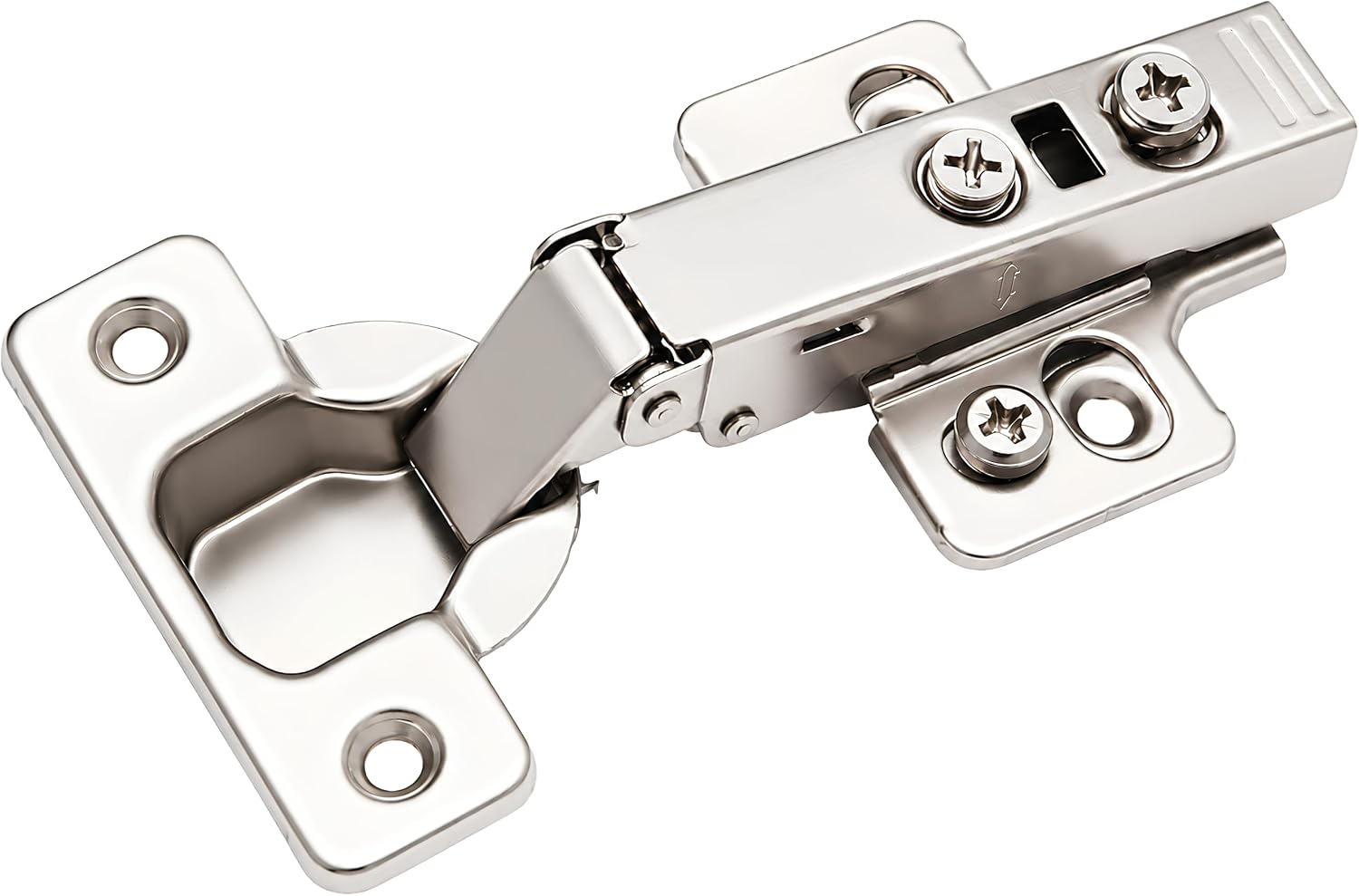
Berta
$22.55
In stock on Amazon
Check price on AmazonPremium-Tier Hinges: Blum CLIP top BLUMOTION and Comparable Engineered Systems
Blum’s CLIP top BLUMOTION is the most widely documented concealed hinge platform in North American kitchen and bath construction. Blum’s published specification sheets rate BLUMOTION for 50,000 open-close cycles. The integrated BLUMOTION dampening mechanism is calibrated by door weight at installation and does not require field adjustment after initial setup. Grass’s TIOMOS Impresso occupies a comparable position in the premium segment with a tool-free opening-angle adjustment that appeals to installers managing high-door-count projects.
The National Kitchen and Bath Association’s 2021 Planning Guidelines acknowledge soft-close as a baseline feature buyers expect in kitchens above the mid-range finish threshold. For a $15,000–$30,000 semi-custom project where long-term resale value is a calculation, premium integrated soft-close is the appropriate default. Houzz community discussions consistently cite soft-close door action as a top perceived-quality signal during buyer showings — often weighted ahead of finish hardware style.
Standardizing on Blum CLIP top across a multi-job contractor workflow also reduces field error: replacement parts are available through virtually every cabinet hardware distributor, and the plate system is consistent across face frame adapter and direct-mount configurations.
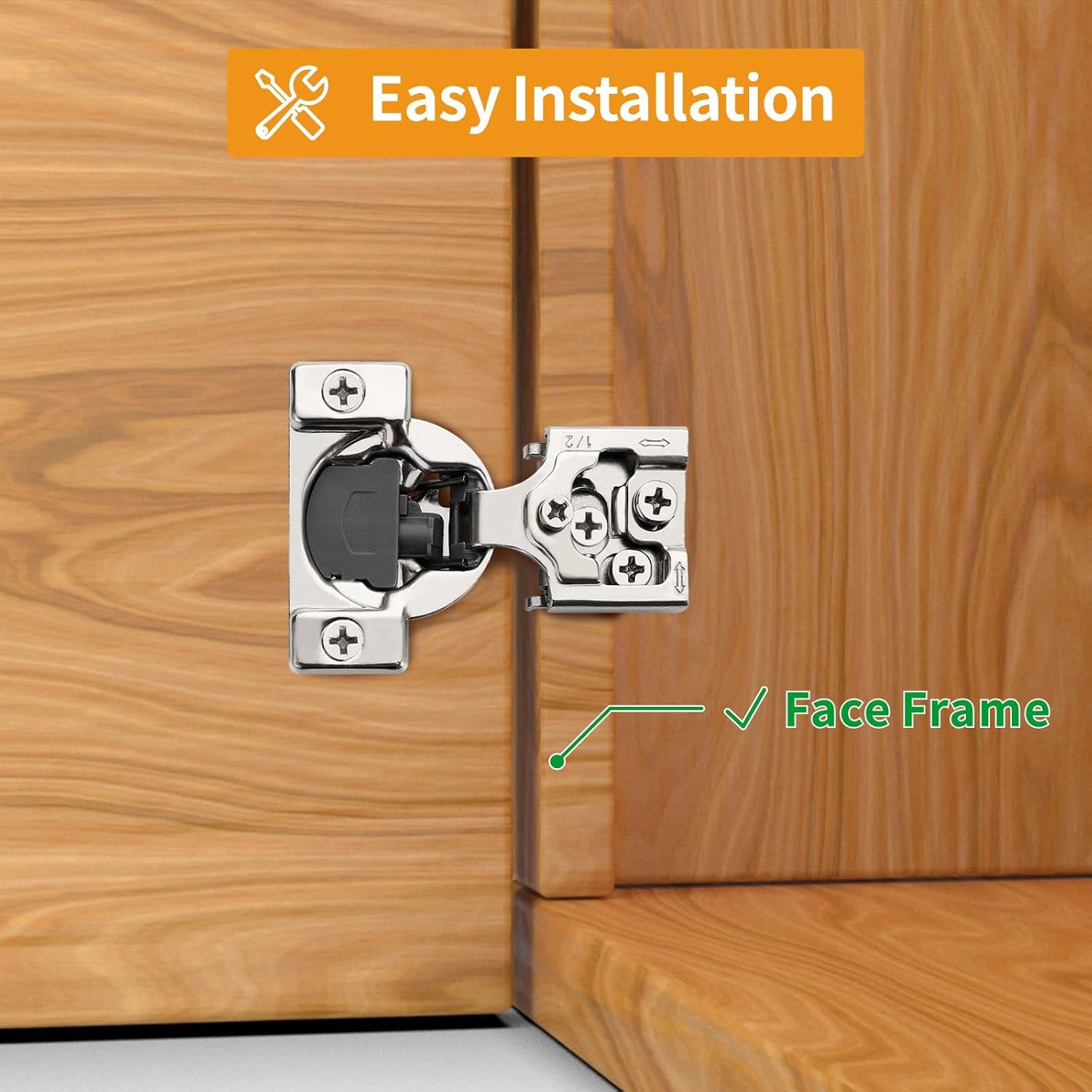
Chibery
$45.89
In stock on Amazon
Check price on AmazonThe Decision Framework: If X, Then Y
Here is the condensed decision logic for a project under active spec review.
If your cabinets are frameless (European-style, full-access): Order standard European full-overlay hinges with direct-mount flat plates. Confirm 35mm cup bore and standard 37mm setback from cup centerline per Häfele’s published hinge selection guidance. If two doors share a cabinet side, order half-overlay hinges for the shared side and full-overlay for the outer sides — or use overlay-adjustable hinges and set them in the field.
If your cabinets are face frame, full overlay: Order hinges rated for face frame application with the correct adapter plate for ¾” frame thickness. Verify overlay depth matches your door-to-door gap spec. This Old House’s cabinet buying guide flags full-overlay miscalculation as the most common overlay error in face frame retrofits — the reveal between adjacent doors on face frame full-overlay is smaller than on frameless full-overlay, and buyers sometimes find the result visually tighter than expected.
If your cabinets are face frame, inset: Standard cup hinges with inset mounting plates work, but wrap hinges — which wrap around the frame edge rather than using a cup bore — are common in traditional American cabinet lines and easier to retrofit without boring new cups. Inset requires the tightest tolerances of any configuration: ±1/16” gap on all four door edges. Confirm door sizing accounts for the reveal before hardware selection, not after.
If you’re managing multiple concurrent jobs: Standardize on one hinge platform. Family Handyman’s European hinge installation guide notes that consistent platform selection across a job site eliminates the most common plate-mixing errors and cuts installation time on repetitive door runs. Blum CLIP top is the most widely stocked platform for field replacement parts; Häfele Metalla is the closest cost-equivalent for volume-sensitive projects.
If the project is a flip optimized for buyer perception: Integrated soft-close is the highest-ROI hardware upgrade available at this price point. Buyers notice door action immediately during showings. You can use a mid-tier brand rather than premium Blum and still achieve the soft-close impression that moves buyer perception at inspection — the mechanism matters more than the nameplate at this use case.
The Bottom Line
The hinge decision is not glamorous, but it is the kind of spec error that compounds: wrong hinges ordered, correct hinges back-ordered, project delayed, installation crew billing for a return visit. The framework is straightforward once you’ve confirmed construction type. Face frame or frameless sets your plate type. Overlay spec sets your hinge geometry. Soft-close integration versus add-on sets your durability tier. Check those three variables against your cabinet spec sheet before you order anything, and you’ll sidestep the most common — and most avoidable — hardware mistake in a kitchen or bath project.