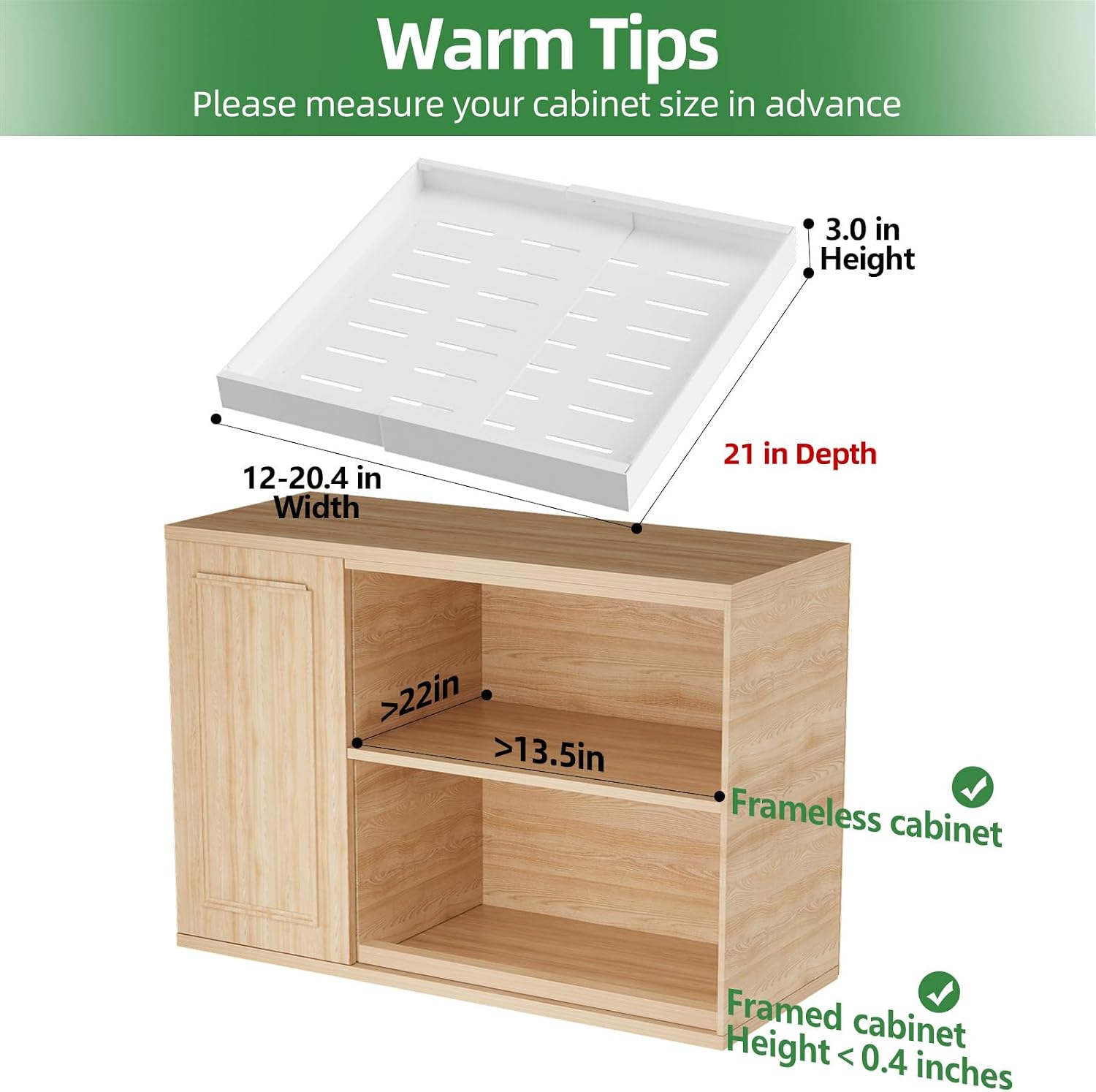
If you’ve ever ordered a pull-out shelf organizer — the kind that slides out of a lower cabinet so you can actually reach the pot buried in the back — and discovered it doesn’t fit once the box is open, you’re not alone. This is one of the most common frustrations in kitchen upgrades, and it almost always comes down to a mismatch between what the product page says and what your cabinet actually measures. A pull-out organizer is simply a shelf or basket mounted on drawer slides (the hardware rails that let it glide in and out) and installed inside an existing cabinet box. They’re one of the highest-ROI kitchen upgrades you can make — owners consistently report getting years of daily use out of a $60–$200 install — but only if the unit fits correctly. This guide walks you through every spec variable that determines fit, so you can match the right product to your exact cabinet before anything ships.
Why “Cabinet Width” on the Product Page Is Not the Number You Need
This is where most buyers go wrong, and it’s not their fault — product listings are inconsistent about which dimension they’re actually reporting.
When a listing says a pull-out organizer is “for a 15-inch cabinet,” it is almost never telling you to measure 15 inches. It’s referencing the nominal cabinet width — the face-frame opening that cabinet manufacturers use to name a cabinet size. The number you actually need is the interior clear width: the usable space between the inside walls of the cabinet box, after accounting for the face frame (the decorative wood border on the front of the cabinet), any existing door hinges that protrude inward, and the thickness of the cabinet box walls themselves.
Per the NKBA Kitchen & Bathroom Planning Guidelines, a standard face-frame cabinet labeled “15 inches” typically delivers between 12.5 and 13.5 inches of interior clear width once the face frame is factored in. A frameless (European-style) cabinet of the same nominal size runs closer to 14–14.5 inches clear, because there’s no face frame eating into the opening.
The practical rule: Before you search for any organizer, take three measurements inside the cabinet:
- Interior clear width — side wall to side wall at the narrowest point, usually at the front where the face frame is closest. Measure at the floor of the cabinet and again at mid-height; some older cabinets are not perfectly square.
- Interior depth — from the back wall to the inside face of the door when closed (not the front of the cabinet box). This tells you the maximum depth of the slide system plus the basket.
- Interior clear height — floor of the cabinet to the underside of the shelf above, or to the top of the opening if it’s a base cabinet with no fixed shelf. This matters for tall pull-out units like pantry organizers and trash can pullouts.
Write all three down before you open a single product page. Everything else follows from those numbers.
Drawer Slide Specs: The Part Listings Bury in the Fine Print
The basket or shelf is the part you see in photos. The drawer slides — the metal rail-and-roller mechanism that actually carries the load — are the part that determines whether the organizer works for five years or five months. Listings frequently lead with the basket dimensions and mention slide specs in a footnote, if at all.
Here are the slide variables that matter most:
Extension type. A full-extension slide (also called 100% extension) lets the basket travel completely clear of the cabinet face frame when open, so you can see and reach everything inside. A three-quarter extension slide (75%) leaves the back 25% of the basket inside the cabinet when fully open — fine for shallow items, frustrating for anything stored toward the back. Family Handyman’s installation guide notes that full-extension slides add $10–$30 per unit to component cost but meaningfully change daily usability, a tradeoff most owners say is worth it in reviews aggregated on Houzz.
Weight rating. Slide systems carry a manufacturer-stated weight capacity, usually stamped on the slide body or listed in the spec sheet. Common ratings run 50 lb, 75 lb, and 100 lb per pair. A bottom cabinet holding cast iron cookware can easily reach 40–60 lb of load; a pantry pull-out stocked with canned goods can exceed that. Owners in long-run Houzz reviews consistently flag undersized slides — typically the 35 lb economy tier — as the first failure point after 18–24 months of heavy use. Match the slide rating to your realistic load, not your optimistic one.
Mounting style: side-mount vs. bottom-mount vs. undermount. Most pull-out organizers sold as retrofit kits use side-mount slides that attach to the interior side walls of the cabinet. This requires a minimum of about 0.5 inches of clearance on each side between the basket and the wall. Bottom-mount and undermount slides attach beneath the basket and are more common in full cabinet builds than in retrofit organizer kits. If your cabinet interior has an existing shelf cleat (a wood strip nailed to the side wall to support a shelf) that protrudes inward, it can block a side-mount slide entirely — check for those before ordering.
Soft-close mechanism. Soft-close slides include a hydraulic damper that catches the basket a few inches before it closes and pulls it in gently. Per published specs across major slide manufacturers, soft-close mechanisms add roughly $8–$20 per slide pair. Apartment Therapy’s measurement guide notes that soft-close is widely reported by owners as the single upgrade they’d never skip on a second install — noise reduction and preventing items from shifting when the drawer closes are the two reasons cited most often.
The Face Frame vs. Frameless Decision Tree
Whether your cabinets are face-frame or frameless is the single biggest variable in retrofit organizer compatibility, and it’s the question most product pages answer with vague language like “fits most standard cabinets.”
Face-frame cabinets are the American standard, dominant in stock lines like Hampton Bay and mid-range RTA brands. The face frame — typically 1.5 inches of solid wood on each side — reduces your interior clear width by 3 inches compared to the nominal cabinet size. It also means the slide must mount behind the face frame, which requires either a slide with a built-in spacer/riser to bring it flush with the opening, or a separate filler block. This Old House’s pull-out shelf guide recommends measuring the face-frame depth (typically 0.75 inches) and confirming that your chosen slide kit includes or accommodates that offset. Many budget kits do not, and the result is a basket that binds against the frame at full extension.
Frameless (European-style) cabinets — common in IKEA SEKTION, higher-end RTA lines, and most Dura Supreme and Fabuwood frameless configurations — have no face frame reducing the interior opening. Slides mount directly to the side walls, and the full interior width is usable. Retrofit kits designed for frameless cabinets are often narrower in their stated width range, so confirm the product’s compatibility statement explicitly references frameless construction.
Quick decision rule: If your cabinets are face-frame and you’re buying a retrofit kit, look for kits that include a rear mounting bracket and state face-frame compatibility explicitly. If the listing says only “fits 15-inch cabinet” without specifying frame type, email the seller before ordering — that ambiguity costs you a return shipping label.
By the Numbers: Common Cabinet Sizes and What They Actually Deliver
| Nominal Cabinet Width | Face-Frame Interior Clear Width | Frameless Interior Clear Width | Typical Pull-Out Basket Width to Order |
|---|---|---|---|
| 12 in | 9.5–10.5 in | 11–11.5 in | 8–9 in (face-frame) / 10–11 in (frameless) |
| 15 in | 12–13 in | 13.5–14 in | 11–12 in / 12.5–13 in |
| 18 in | 15–16 in | 16.5–17 in | 14–15 in / 15.5–16 in |
| 21 in | 17.5–18.5 in | 19.5–20 in | 16.5–17.5 in / 18.5–19 in |
Ranges reflect variation across stock cabinet lines; always measure your specific cabinet. Source: NKBA planning guidelines and published interior dimension specs from major stock cabinet brands.
The pattern is consistent: order a basket approximately 2–3 inches narrower than your measured interior clear width for a face-frame cabinet, and 1–1.5 inches narrower for a frameless cabinet. That gap gives the slides room to mount and the basket room to travel without binding.
Material and Finish: What the Spec Sheet Tells You About Longevity
Pull-out baskets come in three primary materials, each with meaningful tradeoffs for a kitchen or bath environment:
Wire (epoxy-coated or chrome-plated steel) is the lightest and most open option. Items are visible from multiple angles and spills drain rather than pool. The tradeoff: small items (spice jars, packets) can tip through wider wire gaps. Owners in aggregated Houzz project reviews note that epoxy-coated wire holds up better than chrome in humid under-sink environments, where chrome plating can pit over three-plus years of moisture exposure.
Solid wood or plywood with a melamine interior is common in higher-end retrofit kits and matches the look of cabinet interiors more closely. Published specs from mid-range kit manufacturers typically use 0.5-inch or 0.75-inch plywood for the basket body. The 0.75-inch plywood construction is meaningfully stiffer under the 50–75 lb loads a lower cabinet sees; owners consistently flag flex and racking as the failure mode on thinner-wall wire or MDF-body baskets over time.
Polymer/plastic baskets are the budget tier. They’re lightweight and easy to clean, but long-run Houzz reviewers note discoloration under UV exposure (relevant for cabinets near windows) and cracking at mounting points after repeated heavy loads. For a flip where the cabinet gets staging photos and 6–12 months of use, polymer is fine. For a primary residence or a rental you’re managing for 5+ years, the marginal cost of moving up to a wire or plywood basket is hard to argue against.
The “If X, Then Y” Decision Rules
If you have face-frame cabinets and want a retrofit kit, confirm the product explicitly states face-frame compatibility and includes a rear mounting solution — otherwise budget for filler blocks or a different product.
If the cabinet will hold more than 40 lb of load (cookware, canned goods, under-sink supplies), buy the 75 lb or 100 lb rated slide, not the economy 35 lb tier.
If you’re spec’ing for a rental, a flip, or a project where a homeowner will take over maintenance, choose full-extension over three-quarter extension — the usability difference is immediately visible to buyers and renters, and owners in long-run reviews overwhelmingly prefer it.
If you’re doing more than three or four cabinets in a single project, check whether the manufacturer offers a volume kit or contractor pack before ordering individual units — several mid-range organizer brands publish contractor pricing on request that can run 15–20% below single-unit retail at the 10-unit threshold.
Getting pull-out organizers right is mostly a measurement and spec-matching exercise, not an instinct one. Take the three interior dimensions, match them against the slide compatibility statement, confirm the weight rating against your realistic load, and the rest is straightforward. The organizers that owners consistently describe as “still perfect after four years” are the ones where someone did exactly this math before clicking buy.