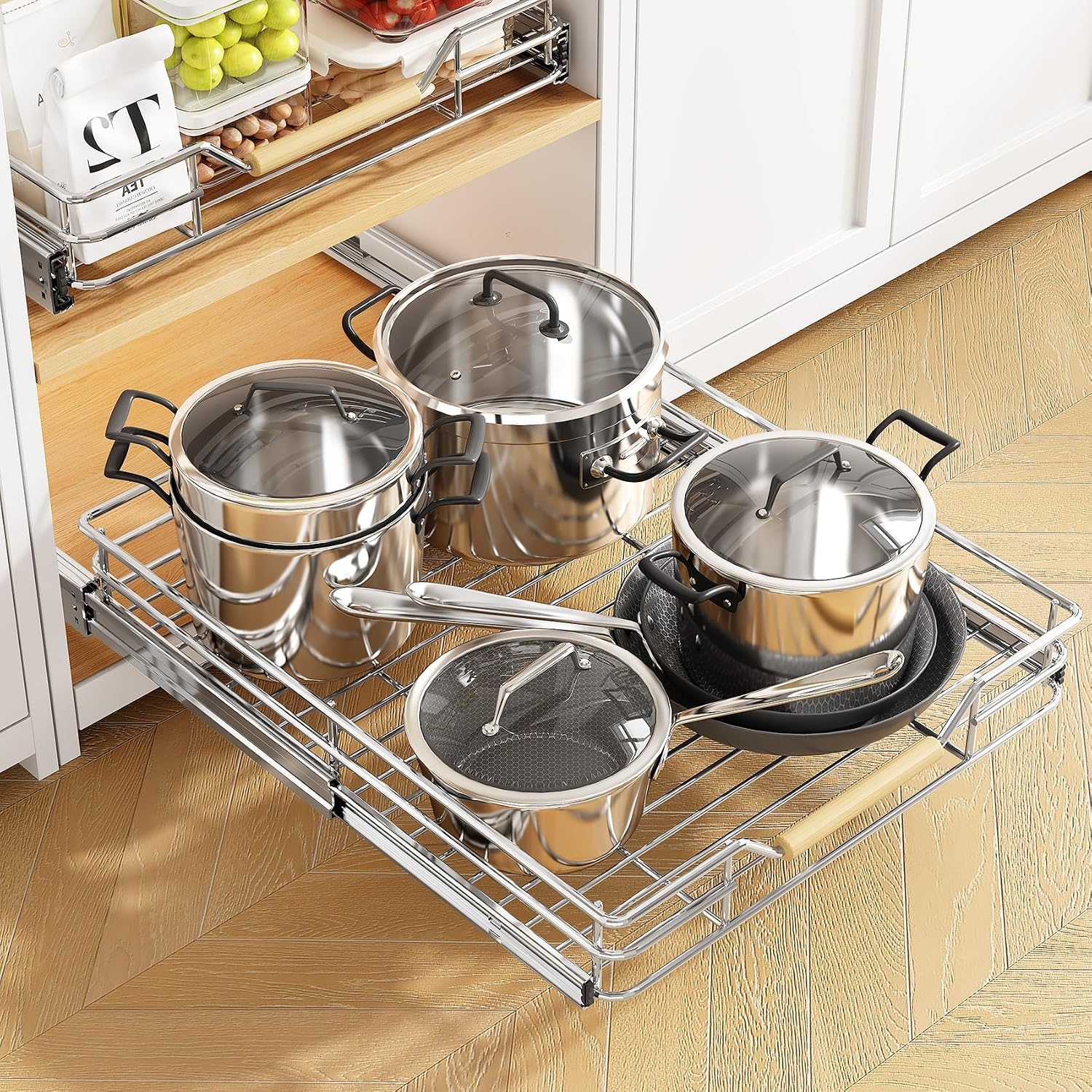
If you’ve ever gotten down on your hands and knees to dig a Dutch oven out of the back of a lower cabinet — the kind where the thing you want is always the last one in — you already understand the problem this article is about. A standard base cabinet (the lower storage unit below your kitchen counter) is typically 24 inches deep, but most of that depth is essentially dead space once you stack a few pots in front. Pull-out shelf organizers are slide-out wire or metal platforms that mount inside the cabinet and roll forward on a track, bringing the back of the cabinet to you instead of making you go to it. The difference sounds small. Owners consistently describe it as transformative. This article breaks down what to expect from the two most-discussed options in this price tier — Seinloes and PAKETA — including the real limitations reviewers flag, which installation method holds heavy cookware safely, and a clear decision guide for the choices most buyers get wrong.
| EDITOR'S PICK[Seinloes 4 Pack Expandable Pull](https://www.amazon.com/dp/B0D3LL3VFX?tag=greenflower20-20)… | Mid-tier[Seinloes 2Pack Expandable Pull](https://www.amazon.com/dp/B0D3LL3VFX?tag=greenflower20-20)… | Budget pick[Pull out Cabinet Organizer](https://www.amazon.com/dp/B0DJ73NCSJ?tag=greenflower20-20) | |
|---|---|---|---|
| Pack count | 4 | 2 | 1 |
| Width range | Adjustable | Adjustable | 15" fixed |
| Raising pad | ✓ | ✓ | — |
| For framed cabs | ✓ | ✓ | — |
| Slide rails | 3 | 3 | — |
| Price | $109.99 | $55.97 | $39.97 |
| See on Amazon → | See on Amazon → | See on Amazon → |
The Deep-Cabinet Problem, by the Numbers
Before we get into products, it helps to understand exactly what you’re working with — and what a pull-out shelf can and can’t fix.
By the numbers:
- Standard base cabinet interior depth: ~23–24 inches
- Usable rear depth unlocked by a pull-out shelf fully extended: approximately 11–13 inches of previously inaccessible space
- Typical weight rating for metal-framed expandable pull-outs: 50–75 lbs per manufacturer spec sheets
- Base-cabinet accessibility: identified by the NKBA (National Kitchen & Bath Association) in its Kitchen & Bath Market Index as one of the top three kitchen storage pain points among homeowners
That second figure is the one worth sitting with. A candid four-star Seinloes reviewer noted plainly: you’re not getting the full 24 inches of usable rolling depth. The shelf itself occupies space, the face frame (the wooden border around the cabinet opening on traditional American-style cabinets) cuts into the front opening, and drawer-slide hardware takes a fraction more. What you actually gain is reliable access to the rear 11–12 inches that was previously a black hole. That’s still a meaningful improvement — it just isn’t magic.
The NKBA Kitchen & Bath Market Index consistently identifies base-cabinet accessibility as a top-three kitchen storage complaint among American homeowners, which explains why this product category expanded sharply in the 2023–2025 cycle.
Seinloes vs. PAKETA vs. Fixed-Width Alternatives: Three Tiers of the Pull-Out Shelf Market
The expandable pull-out shelf category breaks into three meaningful tiers: entry-level expandable units (Seinloes), mid-tier expandable units with face-frame features (PAKETA), and fixed-width heavy-duty units for dedicated high-load applications. Understanding what differentiates them prevents the most common buyer mistakes.
Seinloes Expandable Pull-Out Shelf — Entry-Level Expandable
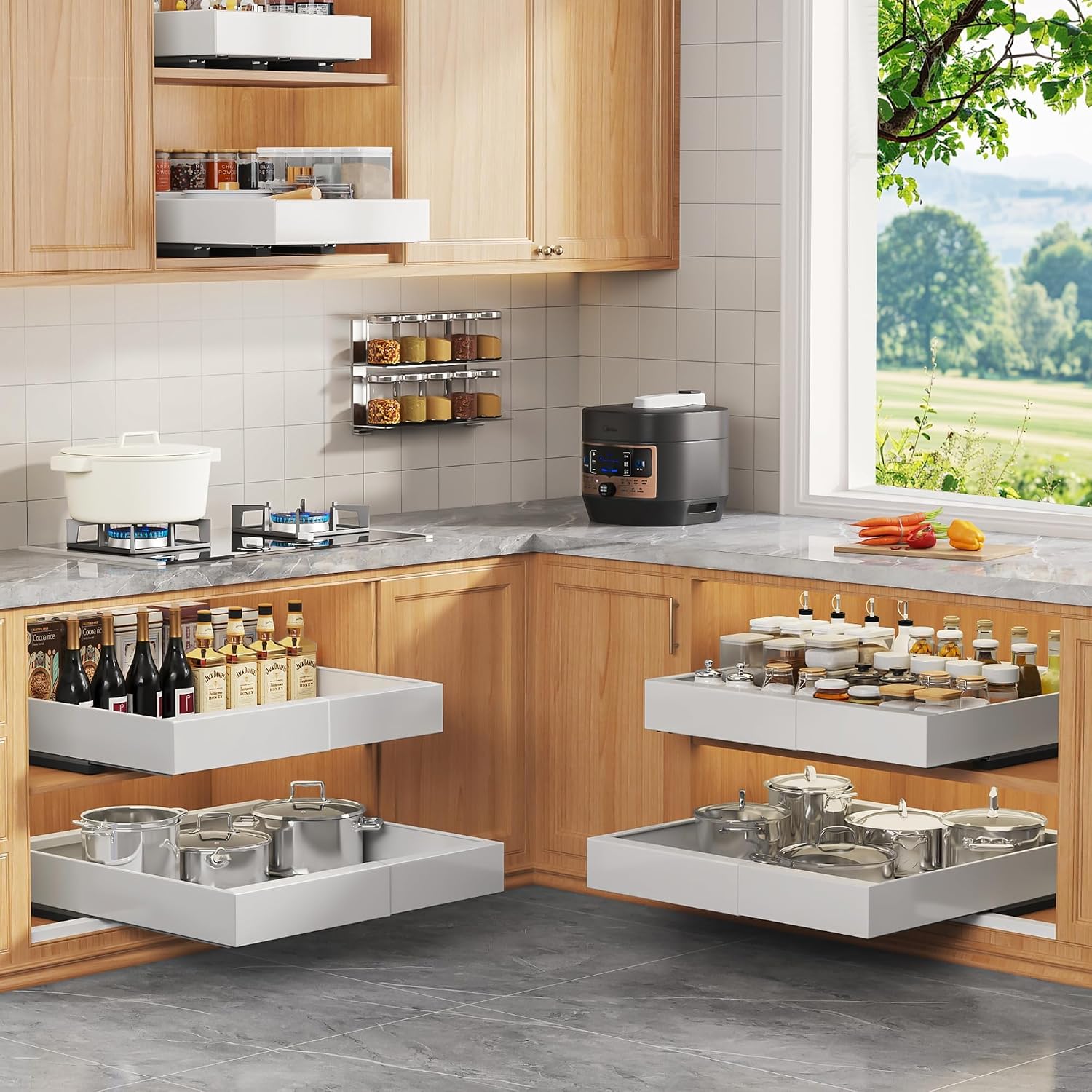
Seinloes reviews aggregated on Houzz across 2023–2025 consistently use the word “sturdy” — several owners specifically note surprise that the metal construction looks and feels more expensive than the price suggests. This matters for a pots-and-pans application, where you’re loading 10–15 pounds of cast iron or stacked stainless onto a platform that slides in and out hundreds of times a year.
The expandable-width feature is genuinely useful — it lets one SKU fit a range of cabinet widths, from roughly 17 inches to 28 inches depending on the model — but here is the honest limitation you need to know before buying: one of the most useful four-star Seinloes reviews flags that the expandable width adjustment does not lock securely on its own. The reviewer describes the shelf gradually narrowing over time under load unless you add a secondary fastening step (typically a few wraps of plumber’s tape around the telescoping rod, or a small machine screw through the overlap joint). The fix is easy and costs almost nothing, but the manufacturer’s included instructions don’t emphasize it, and owners who skipped it report the problem within a few months.
The same reviewer also noted that one shelf arrived slightly warped — not enough to return, but enough to cause a minor wobble. This isn’t a systemic issue across the review pool, but it’s worth inspecting your unit before final installation rather than after.
Best for: Frameless or face-frame cabinets where you want flexible width coverage at the lowest cost per unit. Add the secondary width-lock step before loading anything heavy.
Pull
$39.97
In stock on Amazon
Check price on AmazonPAKETA Expandable Pull-Out Shelf — Mid-Tier Expandable with Face-Frame Compatibility
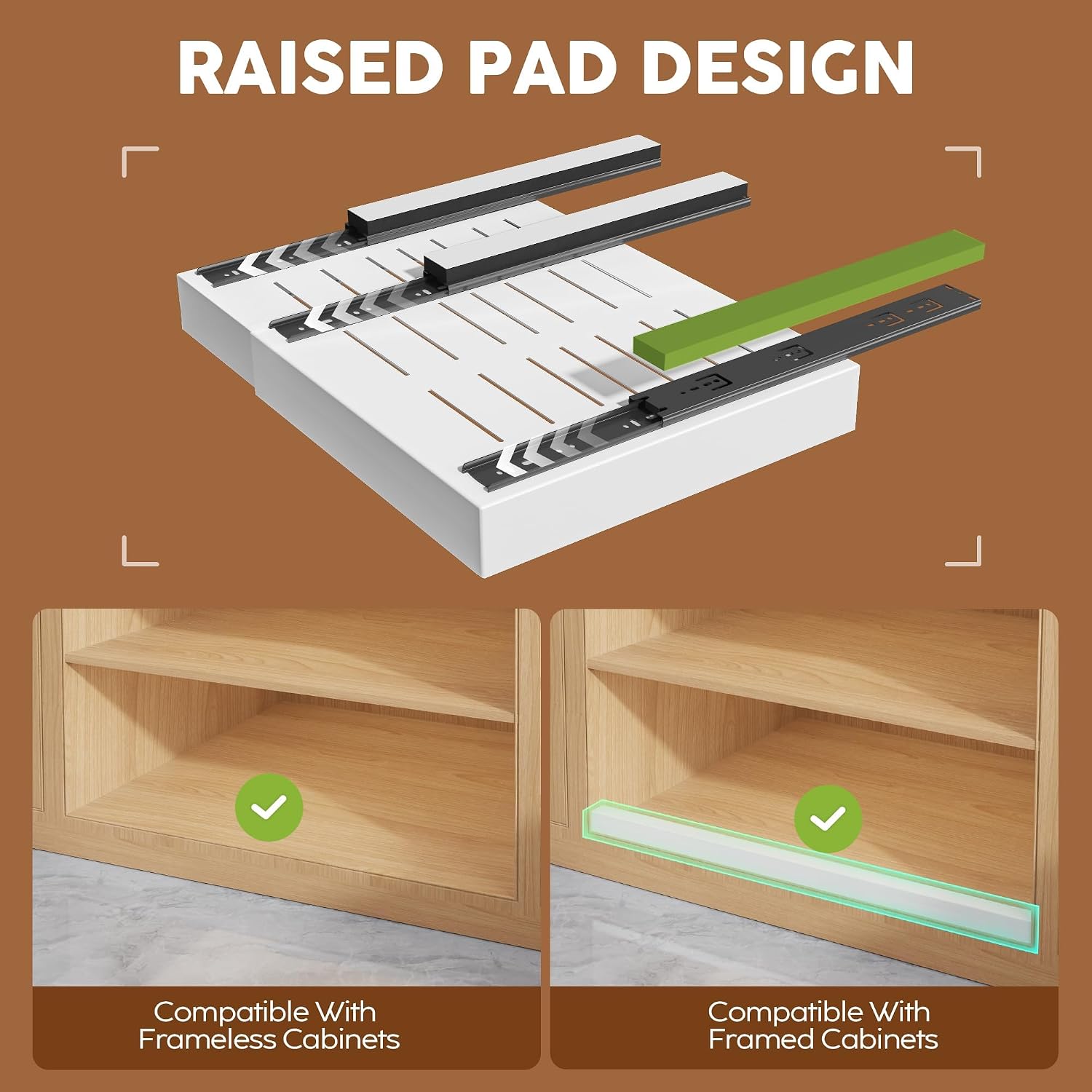
PAKETA reviews skew slightly higher on fit-and-finish consistency than Seinloes. The feature that gets called out most specifically by owners is the included raising-pad system — small spacer pads that elevate the shelf frame to clear the face frame on traditional face-frame cabinets. This is a detail that separates products designed by people who actually thought about cabinet anatomy from those that didn’t.
This Old House, in its coverage of cabinet storage upgrades (“Cabinet Storage Upgrades That Actually Work,” 2024), notes that face-frame compatibility is one of the most commonly overlooked specs when buyers shop pull-out organizers. It’s not a problem with frameless European-style cabinets like IKEA SEKTION, but it’s a genuine installation failure point with traditional American cabinetry — the shelf binds against the frame on extension, creating drag and eventually damaging the finish on both surfaces.
PAKETA’s raising pads solve this out of the box. If your kitchen has face-frame cabinets (the most common construction in American homes built before 2005), this feature alone justifies the modest price premium over entry-level units.
Apartment Therapy, in its 2025 overview of under-cabinet organizers (“The Best Under-Cabinet Organizers We’ve Found”), notes that metal-framed units in this category consistently outperform plastic alternatives in long-run owner satisfaction — a finding that applies to both PAKETA and Seinloes relative to cheaper plastic-bodied competitors.
Best for: Face-frame cabinets with heavy cookware. The included raising pads handle the face-frame clearance problem without modification. Screw installation strongly recommended; see the installation section below.
Seinloes
$55.97
In stock on Amazon
Check price on AmazonFixed-Width Heavy-Duty Pull-Out Shelves — High-Load Dedicated Applications
Fixed-width pull-out shelves are cut to a specific dimension and lack the telescoping side rail of expandable units. The tradeoff is straightforward: you need to measure precisely and order the correct size, but you gain a more rigid platform with no adjustable joint to creep or loosen under load.
Family Handyman, in its installation guide “How to Install Pull-Out Cabinet Shelves” (2024), distinguishes this category from expandable units on the basis of load-cycling performance — fixed-width units with full-extension drawer slides are the appropriate choice when a single shelf will be loaded and unloaded multiple times daily with weights above 30 pounds. For a dedicated cast iron cabinet or a shelf that will hold a stand mixer and accessories, a fixed-width unit with screw-mounted full-extension slides outperforms expandable units over a multi-year timeframe.
The limitation: less flexibility. You need accurate measurements, you can’t reuse the unit in a differently-sized cabinet, and the per-unit cost is typically higher. For a full kitchen refit across multiple cabinets of varying widths, the expandable units above are more practical. For one or two dedicated heavy-use cabinets, fixed-width is the more durable long-term solution.
Best for: Single-cabinet heavy-load applications — cast iron collections, stand mixers, Dutch ovens stored daily. Measure twice; these are not returnable after cutting.
Seinloes
$109.99
In stock on Amazon
Check price on AmazonInstallation: Adhesive vs. Screw — This Is Not a Close Call for Cookware
Both expandable products include adhesive mounting as an option. Based on aggregated owner reviews, treat that as a convenience feature for lightweight applications only — not a real solution for pots and pans.
Reviewers who installed for heavy cookware, and specifically those with cast iron collections, consistently recommend screw installation. The failure mode for adhesive-only installation under heavy load is gradual: the shelf doesn’t collapse immediately, it slowly separates from the cabinet floor over six to twelve months of loading and unloading. By the time you notice, you’ve usually had the wobble long enough to dismiss it as normal — and then one day the shelf tilts and something heavy slides.
Family Handyman’s installation guide for pull-out cabinet shelves (“How to Install Pull-Out Cabinet Shelves,” 2024) is direct on this point: adhesive strips are rated for static loads, not the repeated dynamic loading of a shelf that’s pulled in and out while holding 20–30 pounds. Drilling four pilot holes and driving screws takes about eight minutes. Do it.
Face-Frame vs. Frameless: Which Cabinet Type Do You Have?
This is the question that trips up the most buyers, so it’s worth a clean explanation before the FAQ section.
Face-frame cabinets have a solid wood border attached to the front of the cabinet box. This frame reduces the interior opening slightly and sits proud of the interior floor. Most American-built kitchens constructed before 2010 use this design. Pull-out organizers for face-frame cabinets need either a raising pad (like PAKETA includes) or a mounting system that attaches to the sides rather than the floor.
Frameless cabinets (also called “full-access” or “European-style”) have no border frame — the door attaches directly to the box. IKEA SEKTION is the most widely recognized frameless line in the U.S. market. The interior opening is the full box width, and the floor runs edge-to-edge. Pull-out organizers mount cleanly without the raising-pad complication, but you need to confirm the internal width before ordering an expandable unit.
If you’re not sure which type you have: open the cabinet door and look at the inside edge of the opening. If you see a 1–1.5 inch wood border between the door opening and the cabinet interior, you have a face-frame cabinet.
Frequently Asked Questions
How much of the cabinet depth do pull-out shelves actually make accessible?
Not the full 24 inches — plan on reliable access to roughly 11–13 inches of rear depth that was previously unreachable without crouching. The shelf frame, mounting hardware, and front-face-frame clearance all consume some of the theoretical total. The practical improvement is still significant: the back third of the cabinet, which is where everything gets lost, becomes accessible without getting on your knees.
Will these hold cast iron pots and a stand mixer without tipping or wobbling?
The metal-framed units like Seinloes and PAKETA are spec-rated for 50–75 lbs per manufacturer documentation. Owners with cast iron collections report solid performance — with screwed installation. The wobble that shows up in some reviews is almost always traced to adhesive-only mounting or the Seinloes width-adjustment issue described above. Screw the unit in, confirm the width is locked, and you’re in good shape for heavy cookware.
Do I need to drill into my cabinet to install these safely for pots and pans?
Yes. Both products include adhesive as an option, but owner experience across the review pool is consistent — adhesive-only installation fails under repeated heavy loading over time. Four pilot holes and four screws take less than ten minutes and solve the problem permanently.
What is the difference between expandable-width and fixed-width pull-out shelves?
Expandable-width units use a telescoping side rail so one unit covers a range of cabinet widths — useful across multiple cabinets with varying interior dimensions. Fixed-width units are more rigid since there’s no adjustable joint, but require precise measurement and a separate order for each cabinet size. For a full kitchen with several base cabinets, expandable units are more practical. For one or two dedicated heavy-use shelves, fixed-width is the more durable choice.
Do these work in IKEA SEKTION or other frameless cabinets?
Both work in frameless cabinets — often more straightforwardly, since there’s no face frame to navigate. Measure the interior width of your SEKTION base cabinet (typically 14.75 inches or 29.5 inches for the common 15-inch and 30-inch door sizes) and confirm the organizer’s expanded range covers that dimension. The raising-pad feature is unnecessary in frameless applications.
The Decision Rule
Here’s the clean if/then framework based on everything above:
If you have face-frame cabinets and heavy cookware → PAKETA is the cleaner starting point. The included raising pads solve the face-frame clearance problem out of the box, and fit-and-finish reviews are slightly more consistent. Screw it in; skip the adhesive.
If you have frameless cabinets (IKEA SEKTION and similar) → Either expandable product works well. Seinloes’ expandable range is useful if your cabinets aren’t all the same width. Add the secondary width-lock step before loading anything heavy.
If you have one or two dedicated high-load cabinets → Consider a fixed-width heavy-duty unit over an expandable. The rigidity advantage under daily cast-iron loading compounds over years of use, and the per-cabinet cost difference is modest against the cost of replacing a failed shelf.
If mobility or accessibility is a factor → Reviewers with knee or back limitations describe this product category in notably strong terms. The shift from “crouch and dig” to “roll forward and see everything” is that meaningful for this use case. Prioritize screw installation for long-term reliability; the last thing you want is a shelf that loosens over time when the whole point is reducing physical strain.
The deep-cabinet problem is real, the fix is inexpensive, and the honest limitations here are manageable with a drill and ten minutes. That’s a good ratio.