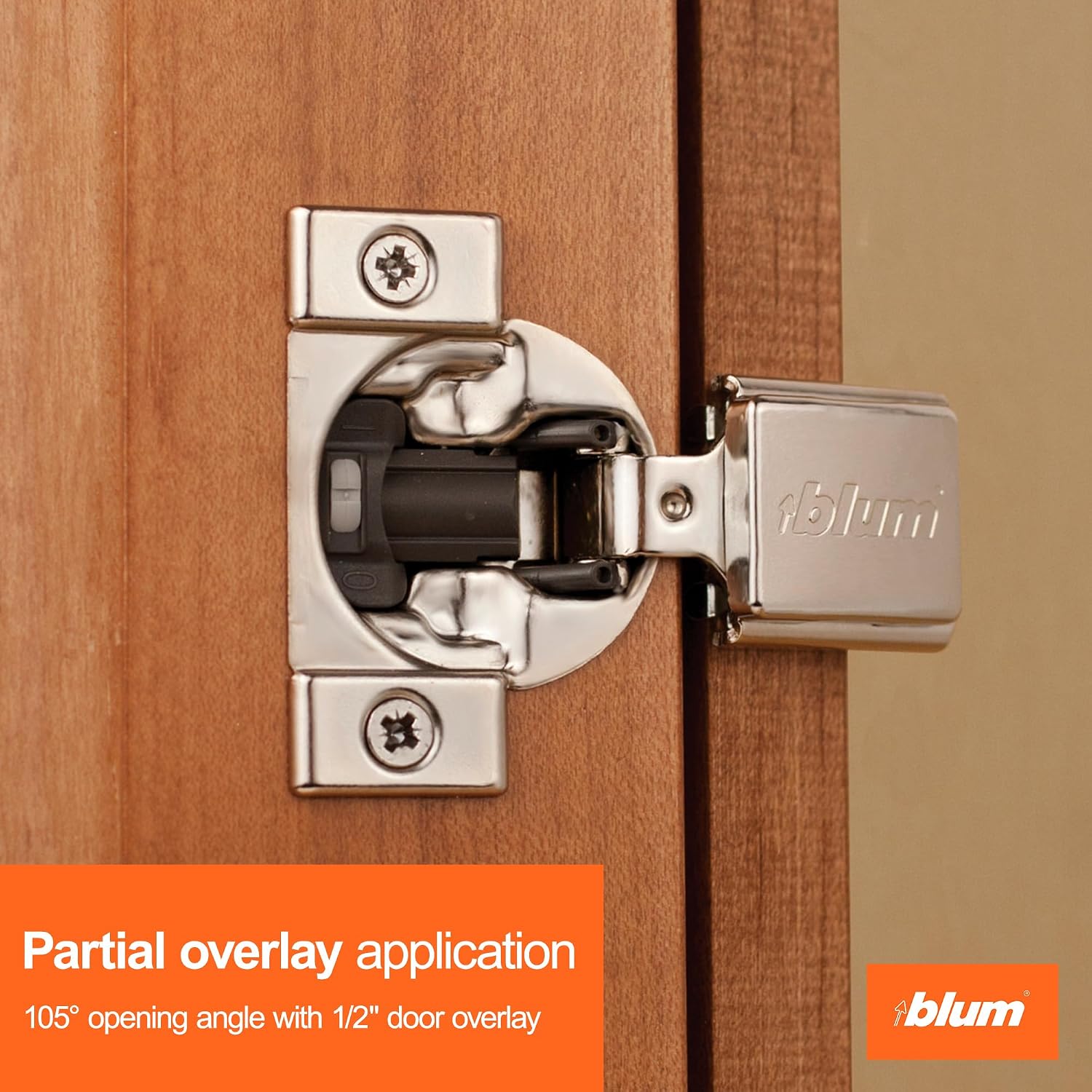
If you’ve ever reached under a cabinet door and heard it slam instead of whisper shut, you already understand why soft-close hinges exist. A soft-close hinge is a door hinge that contains a small internal dampening mechanism — think of a tiny hydraulic shock absorber — that catches the door in the last 15 to 30 degrees of closing travel and slows it to a gentle, silent stop. No slam, no rattled dishes, no chipped door edges over time. They’re now standard in virtually every mid-range and above cabinet line, and even most stock cabinets ship with them. But “soft-close” on a spec sheet covers an enormous range of quality, and choosing the wrong hinge — or the wrong overlay configuration — can mean doors that won’t align, dampeners that fail in two years, or a retrofit that costs more in labor than the hinges themselves. This guide will walk you through the three things that actually matter when you’re spec’ing or sourcing cabinet hinges: overlay type, the three adjustment axes, and whether paying Blum’s premium price is justified for your project.
| EDITOR'S PICK[25 Pack Salice 106 Degree Silen…](https://www.amazon.com/dp/B07ZFTQ8B6?tag=greenflower20-20) | Mid-tier3/4" Blum® Compact Soft-Close B… | Budget pick[Blum Compact BLUMOTION Hinge (1…](https://www.amazon.com/dp/B078H4FL9Z?tag=greenflower20-20) | |
|---|---|---|---|
| Overlay | 1-3/8" | 3/4" | 1/2" |
| Opening angle | 106° | — | 105° |
| Adjustment axes | 2-cam | — | — |
| Mounting type | Screw-on | — | — |
| Quantity | 25 | 10 | 10 |
| Material | — | — | Steel |
| Price | $79.99 | $35.23 | |
| See on Amazon → | See on Amazon → | See on Amazon → |
Overlay Types Explained: Full, Half, and Inset
The word overlay describes how much of the cabinet face frame (or frameless cabinet edge) the door covers when it’s closed. Getting this wrong is the most common and most expensive hinge mistake on a job site — you can’t easily swap a full-overlay hinge into a half-overlay application without redrilling cup holes and potentially filling and re-boring the cabinet door.
Full overlay is the dominant configuration in modern North American kitchens. The door covers nearly the entire face frame stile — typically leaving only about 1/8 inch of the frame visible at each door edge. In frameless (European-style) construction, full overlay means adjacent doors nearly meet at the cabinet partition. This is the default for most RTA lines and semi-custom brands. Blum’s spec sheets confirm their standard CLIP top hinge covers a 1/2-inch overlay, while their “1/2 overlay” variant steps down to cover less — terminology that can genuinely confuse buyers who read “1/2 overlay” as a lesser product rather than a specific application.
Half overlay (sometimes called “standard overlay”) is used where two doors share a center partition — one door’s hinge overlaps the partition, the other door’s hinge shares it. This is common in older face-frame construction and still appears in builder-grade stock lines. Half overlay hinges are typically the same mechanical unit; it’s the arm geometry that changes.
Inset is the premium, furniture-grade configuration where the door sits flush inside the cabinet opening. Inset demands the tightest tolerances — even a 1/16-inch box variation shows — and requires a different hinge geometry entirely. Inset hinges are more expensive, harder to adjust, and not something to spec on a fast-turn flip unless you’re sourcing pre-assembled cabinets built for them. Per guidance from This Old House’s cabinet hardware overview, inset doors paired with soft-close mechanisms require dampeners that work through a much shorter closing arc, which rules out many budget hinge lines.
The Three Adjustment Axes: Why They Matter More Than You Think
Every quality concealed hinge — the cup-style hinge that’s been standard in European and now most American cabinets since the 1970s — offers three-dimensional adjustment after installation. Understanding these axes is what separates a finish carpenter who can dial in a 24-door kitchen in an afternoon from one who’s shimming and re-hanging for a full day.
1. Depth adjustment (in/out): This moves the door toward or away from the face frame, controlling how flush the door sits. Most hinges achieve this by loosening the mounting plate screw and sliding the plate. Blum’s CLIP top system uses a lever-release plate that snaps in and out without tools — a genuine time-saver documented consistently in contractor reviews on Houzz, where installers report saving 20–30 minutes on a full kitchen by not chasing a screwdriver for plate releases.
2. Height adjustment (up/down): This raises or lowers the door along the cabinet’s vertical axis. On cheaper hinges, height adjustment requires physically repositioning the mounting plate — meaning you’re re-drilling or using oblong slots. On premium hinges like Blum’s CLIP top or Grass’s TIOMOS line, height adjustment is built into the plate with a cam or screw mechanism that moves the door up to ±2mm without moving the plate itself. For a 10-cabinet kitchen with 20 doors, that difference in adjustment range adds up quickly during final hang.
3. Lateral adjustment (side-to-side): This shifts the door left or right to even reveal gaps between doors and drawer fronts. Most hinges — including mid-tier options — offer at least ±2mm of lateral adjustment via an eccentric screw in the hinge arm. Blum’s spec sheet for the CLIP top BLUMOTION puts lateral adjustment at ±2mm, consistent with the industry standard. Where Blum differentiates is the tactile feedback of the adjustment screws — owners consistently report the incremental feel is more predictable than no-name alternatives, which tend to have sloppier threads.
The practical point: On a high-end semi-custom install where reveal consistency is scrutinized — or on a flip where you’re hanging stock cabinets that weren’t perfectly shimmed level — fine-grain adjustability saves labor hours. On a rental unit getting Hampton Bay box cabinets, you may not care.
By the Numbers
| Hinge Tier | Avg. Cost per Pair | Adjustment Range (lateral) | Dampener Rated Cycles | Adjustment Tool Required |
|---|---|---|---|---|
| Budget (no-name import) | $0.80–$2.00 | ±1–1.5mm | 50,000–80,000 | Phillips screwdriver |
| Mid-tier (Rok, Amerock) | $2.50–$5.00 | ±2mm | 100,000+ | Phillips screwdriver |
| Blum CLIP top BLUMOTION | $5.50–$9.00 per pair | ±2mm | 200,000 (manufacturer-rated) | No-tool plate; screwdriver for arm |
| Grass TIOMOS | $6.00–$10.00 per pair | ±2mm | 200,000 (manufacturer-rated) | No-tool or tool-dependent by model |
Pricing based on contractor-volume sourcing as of mid-2026. Retail single-pair pricing runs 30–60% higher.
What Blum’s Premium Actually Buys You
Let’s be direct: Blum is the most-cited hinge brand in North American cabinetry, and their CLIP top BLUMOTION line commands a price that’s roughly 3–5x a budget import and 1.5–2x a solid mid-tier hinge. The NKBA’s Kitchen & Bath Market Index for Q4 2025 continues to list Blum among the top three specified hardware brands by designers and kitchen dealers. Is the premium justified? Based on published specs and aggregated owner experience, here’s the honest breakdown.
What you’re actually paying for:
Integrated dampening, not a bolt-on. Budget soft-close hinges often achieve dampening by inserting a separate plastic mechanism into the hinge cup or gluing a dampening pad to the face frame. Blum’s BLUMOTION dampener is engineered into the hinge arm itself. Owners on Houzz’s kitchen hardware forums consistently note that third-party add-on dampeners — the little cylindrical bumpers sold as a cheap retrofit — start failing within 18 months of heavy use, while integrated mechanisms in premium hinges hold up past the three-year mark with no maintenance. Family Handyman’s installation guidance also notes that integrated dampeners eliminate the alignment headaches that come with positioning separate soft-close attachments.
Cycle rating. Blum rates the CLIP top BLUMOTION at 200,000 open-close cycles per their published specification sheet. At 20 cycles per day on a heavily used cabinet — think a pantry door or a cabinet next to a range — that’s 27 years of daily use before reaching the rated limit. Budget hinges rarely publish cycle ratings at all; when they do, 50,000–80,000 cycles is typical. For a rental property or a flip, this matters less. For a primary kitchen where you’re standing behind a quality representation, it matters a lot.
Tool-free plate release. This is a labor argument as much as a quality argument. On a 10x10 kitchen with 20 doors, being able to snap doors on and off the mounting plates for final adjustments without a screwdriver saves real time. Contractors running multiple concurrent jobs have noted in Houzz discussions that the time savings on Blum CLIP top installation pays back roughly half the hinge premium on a full-kitchen install, compared to screw-mount plates.
Adjustment thread quality. This is where budget hinges most often disappoint. The eccentric cam screws that control lateral adjustment strip more easily and have larger incremental jumps, making micro-adjustments frustrating. Blum’s adjustment screws are machined to tighter tolerances — per their spec documentation — and owner reviews consistently describe the adjustment experience as more “controlled.”
Where the premium is harder to justify:
On stock cabinet flips, investor-grade rentals, or projects where the hinge will be painted over and never touched after install, the gap between a $2 import and an $8 Blum hinge is harder to defend in cost-per-project terms. A 10x10 kitchen with 20 doors uses roughly 40–50 hinges. At $8 per pair vs. $2 per pair, that’s $200 vs. $50 — a $150 spread. That’s not nothing, but it’s also not a budget-breaking decision on a $15,000 project.
The mid-tier case — brands like Grass’s TIOMOS or Häfele’s Metalla SM — is compelling for exactly this reason. Grass publishes a 200,000-cycle rating matching Blum, offers tool-free mounting plates on their higher models, and comes in at roughly 10–20% below Blum pricing through contractor channels. Per aggregated installer reviews, the functional difference between Blum and Grass at the top spec level is negligible for most applications. The gap between either of those and an unbranded import is significant.
The Decision Rule: If X, Then Y
Here’s how to translate all of this into a sourcing decision for your current project:
If you’re doing a semi-custom or designer-adjacent kitchen ($8,000+ cabinetry budget, owner staying long-term, high reveal-consistency expectations) → spec Blum CLIP top BLUMOTION or Grass TIOMOS. The integrated dampening, cycle rating, and adjustment quality support the price at this tier. Per the NKBA’s market data, these are the expected specification at this project level.
If you’re doing a mid-range RTA install (Lily Ann, The RTA Store, Cabinet Now) where quality matters but the owner isn’t scrutinizing hinge-brand pedigree → use a solid mid-tier hinge (Amerock, Rok, or Häfele Metalla) or accept the hinges the RTA brand ships. Most established RTA brands now ship Blum or a Blum-equivalent; verify before sourcing separately.
If you’re doing a flip or investor-grade rental where total cost control is the mandate → budget imports are acceptable IF you use an integrated soft-close design (not a stick-on dampener), buy from a supplier who can confirm cycle ratings, and install one spare hinge per cabinet for future swaps. The $150 savings on a 20-door kitchen moves the needle on margin.
If you encounter inset doors on any project → do not cheap out on the hinge regardless of tier. Inset’s tight tolerances demand fine adjustment range, and a $1.50 hinge will cost you in labor every time.
The hinge spec is one of those decisions that looks like a small line item and quietly determines whether a kitchen feels finished or just functional. Reading the spec sheet before you source — not after the cabinets are on the wall — is the move that separates the practitioners who build a reputation from those who spend Saturdays on callbacks.