If you’re new to kitchen renovations, “under-cabinet lighting” is exactly what it sounds like — LED strips or bar lights mounted to the underside of your upper cabinets to illuminate the countertop below. It’s one of the most cost-effective upgrades in a kitchen project: it makes prep work easier, it photographs well, and buyers notice it during home tours. About six weeks into most kitchen projects, renovators hit the same fork in the road — wire the lighting permanently into the home’s electrical system (hardwired), or install battery-powered or USB-rechargeable units that go up in an afternoon without touching a breaker panel (rechargeable). Both categories have matured considerably since 2022. This article breaks down what the specs, cost math, and aggregated owner experiences actually say — so you can make the call that fits your project, your timeline, and your budget.
The Core Tradeoff: Permanence vs. Speed
Here’s the honest summary before getting into the weeds: hardwired under-cabinet lighting is the better product in almost every technical dimension, and rechargeable lighting wins on installation speed and project flexibility. The question is which of those two things matters more on your specific job.
Hardwired systems use low-voltage LED puck lights or continuous LED bar lights wired back to a dedicated circuit or a switched outlet hidden inside the cabinet. Light output is consistent — no dimming as a battery drains, no dark zones because someone forgot to charge a unit. Color rendering index (CRI — a measure of how accurately a light source shows true colors, where 90+ is considered excellent for kitchens) tops out higher in hardwired commercial-grade strips. Dimmer compatibility is standard. And critically for anyone thinking about resale: a hardwired system reads as a finished, permanent feature to an appraiser or a buyer’s agent. According to the National Kitchen and Bath Association’s Kitchen Planning Guidelines 2024 (nkba.org), under-cabinet task lighting is now considered a baseline expectation in mid-range and above kitchen renovations — not a discretionary upgrade.
Rechargeable systems have closed a lot of ground since 2022. The best units now push 300–500 lumens per bar (lumens measure raw light output), offer motion-sensor activation, and carry CRI ratings in the mid-80s. Magnetic mounting means a clean install in twenty minutes. The tradeoff is maintenance: batteries degrade, USB charging is a recurring task, and in a rental or flip scenario, you are handing that maintenance obligation off to whoever comes next. Kitchen lighting discussion threads on Houzz consistently show the same complaint pattern: battery-powered units become inconsistent at the 18–24 month mark as cells degrade — not immediately, but reliably.
By the Numbers
| Specification | Hardwired LED Bar/Strip | Rechargeable LED Bar |
|---|---|---|
| Installed cost (10-ft run, pro labor) | $280–$550 | $60–$180 (DIY) |
| Lumen output (typical) | 400–900 lm/ft | 200–500 lm/bar |
| CRI range | 90–97 | 80–90 |
| Expected lifespan | 25,000–50,000 hrs | 500–1,000 charge cycles |
| Dimmer compatible? | Yes (most systems) | Limited (brand-specific) |
| Permit/inspection trigger? | Often yes | No |
Sources: This Old House under-cabinet lighting installation guide (thisoldhouse.com); Family Handyman under-cabinet lighting installation guide (familyhandyman.com); manufacturer-published spec sheets for major residential LED brands.
Installation Reality: What the Specs Don’t Tell You
The cost gap looks significant on paper — $280–$550 installed for hardwired versus $60–$180 in materials for rechargeable — but the full picture is more nuanced.
For a full kitchen renovation already in progress, adding hardwired under-cabinet lighting is cheapest when walls are open. An electrician running a circuit to upper cabinet zones during a gut renovation typically adds $150–$300 to the electrical scope, not $550. The expensive scenario is retrofitting hardwired lighting into a finished kitchen, where fishing wires through closed walls and ceilings drives labor cost up sharply. This Old House’s under-cabinet lighting installation guide (thisoldhouse.com) notes that retrofit hardwired jobs in finished kitchens routinely run $400–$800 or more depending on wall construction and distance to the panel.
For flips and rentals, the permit question matters. In most jurisdictions, hardwired electrical work requires a permit and inspection, which adds one to three weeks to a timeline and $75–$250 in permit fees. For a house-flipper on a tight 60-day close timeline, rechargeable lighting installed the week before listing is often the rational call — not because it’s better, but because it ships the product on schedule. Architectural Digest’s kitchen lighting coverage (architecturaldigest.com) consistently frames rechargeable puck and bar lights as viable staging and timeline-constrained renovation tools even in higher-end projects, precisely because of that flexibility.
For a semi-custom kitchen where the buyer is moving in and living there — a $12,000–$25,000 cabinet project — this calculus flips. Owners who invest at that level expect finished details. Apartment Therapy’s aggregated under-cabinet lighting reviews (apartmenttherapy.com) note that hardwired systems draw consistent praise from owners at the two- and three-year marks specifically because “it just works every time” — no dead units, no charging ritual, no explaining to family members why one section of the counter is dark. At the semi-custom tier, the $200–$300 premium for hardwired during an open-wall renovation is close to noise against total project cost.
Comparing the Two Approaches by Project Type
Budget Renovations and Rental Properties
At the stock-cabinet tier — roughly $80–$150 per linear foot — every dollar in the project budget is accounted for. Rechargeable lighting in the $25–$45 per bar range delivers real, visible value without requiring a permit, an electrician, or wall patching. For rental properties, the absence of hardwired electrical work also simplifies maintenance responsibilities: there’s no wiring to troubleshoot, and units can be swapped without a service call. The practical floor for rechargeable quality at this tier is CRI 80; units in the CRI 85–90 range cost modestly more and represent a meaningful step up in daily usability. A well-chosen rechargeable bar at CRI 90+ photographs identically to hardwired — relevant for flip listings where the kitchen will be on the market before any long-term user experiences the maintenance reality.
 product image](/images/external/84d7cb91c3ec.jpg)
MCGOR
$15.94
In stock on Amazon
Check price on AmazonMid-Range Renovations with Partial Wall Access
The mid-range scenario — semi-stock or value semi-custom cabinets, countertops being replaced, but not a full gut — is where the decision gets genuinely complicated. If the wall behind the upper cabinets is accessible from above (through an open soffit or attic space), hardwired retrofitting becomes much more cost-competitive. Family Handyman’s under-cabinet lighting installation guide (familyhandyman.com) details how soffit access can reduce a retrofit hardwired job to $200–$350 in labor by eliminating wall patching entirely. If that access doesn’t exist and walls are closed, rechargeable is the pragmatic call — particularly if a full renovation is planned in the next three to five years, at which point hardwired can be specified from the start. At this tier, prioritize rechargeable units with magnetic mounts and USB-C charging; proprietary connectors and non-replaceable batteries are the two most common sources of mid-term frustration flagged in Houzz kitchen lighting threads.
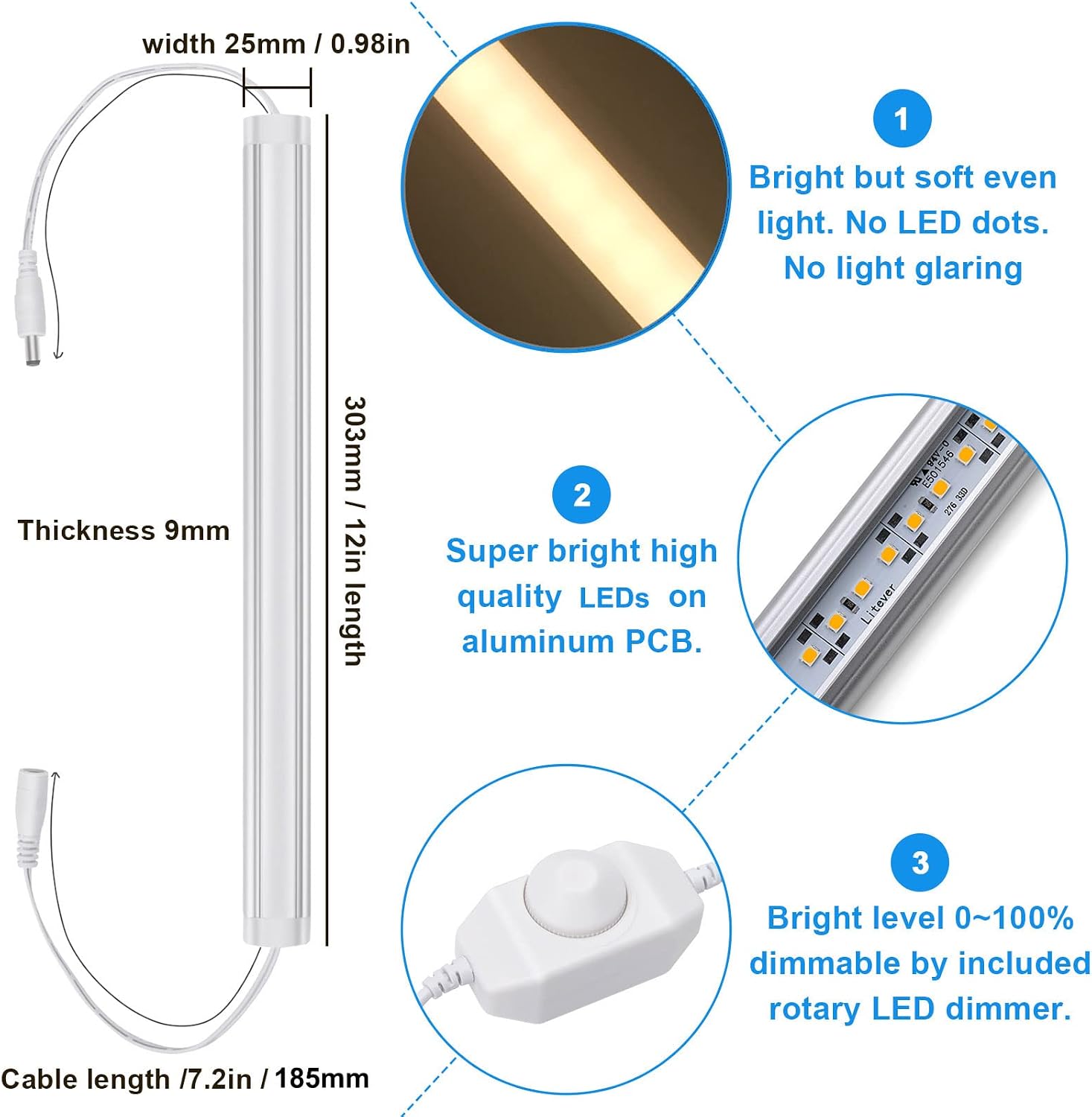
Litever
$47.59
In stock on Amazon
Check price on AmazonPremium and Semi-Custom Renovations
At $8,000 and above in cabinet spend, the lighting specification needs to match the cabinetry specification. Rechargeable units in a high-finish kitchen read as an afterthought to buyers, inspectors, and anyone living in the space for more than a year. The National Kitchen and Bath Association’s Kitchen Planning Guidelines 2024 (nkba.org) frames under-cabinet task lighting as a baseline expectation at this tier — which in practice means hardwired, dimmable, and specified for color temperature at the time of order. The incremental cost during an open-wall renovation is $150–$300 in marginal electrical labor — noise against a $15,000–$25,000 project. Hardwired systems at this tier should specify continuous LED bar (not puck lights, which create hot spots and dark zones), CRI 90 or above, a manufacturer-selectable color temperature option, and a compatible dimmer module. A 24V DC low-voltage system is safer for installations where the homeowner may eventually need to service the driver than line-voltage (120V) hardwired systems, though both still require a licensed electrician in most jurisdictions.
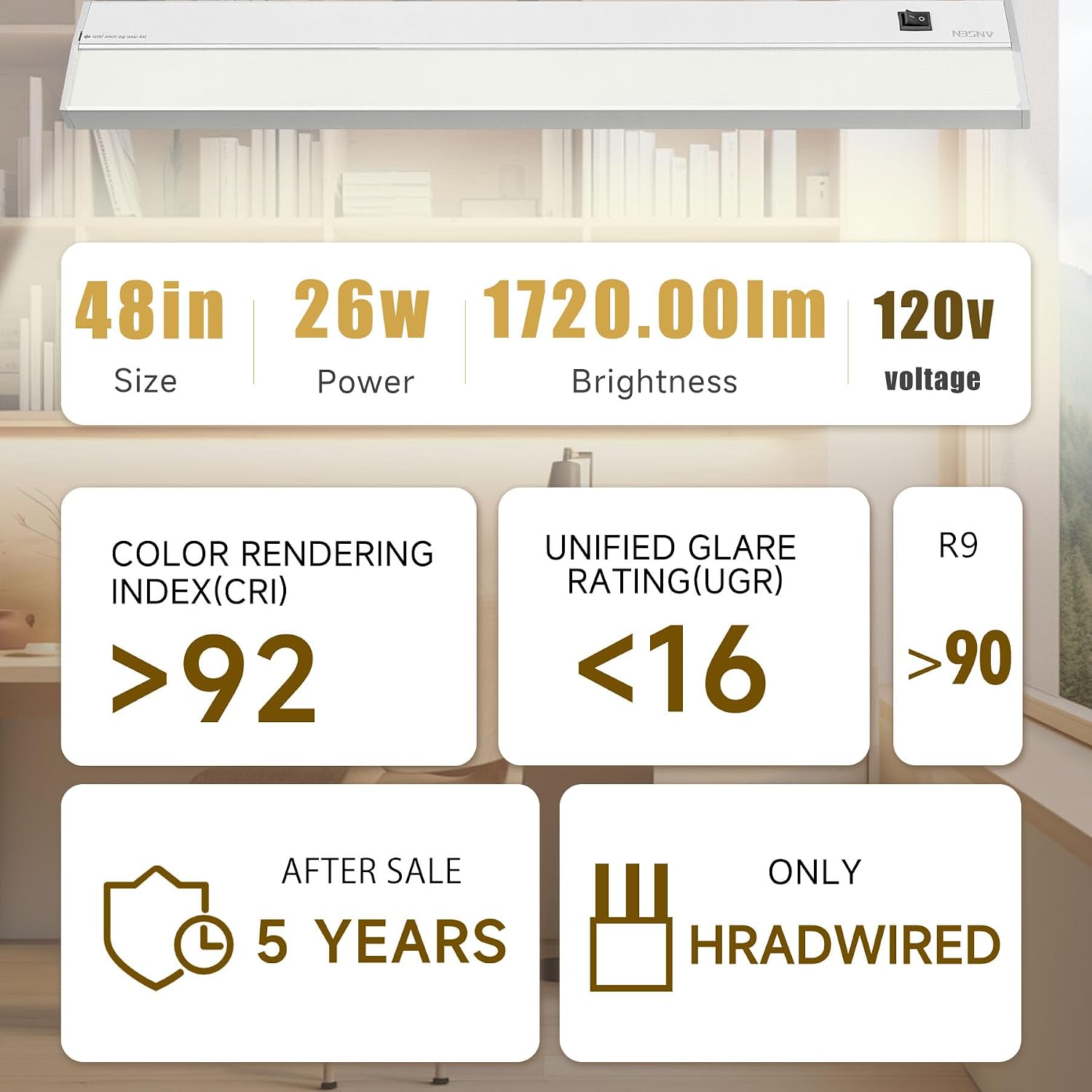
Ansen
$59.99
In stock on Amazon
Check price on AmazonColor Temperature and CRI: The Spec That Actually Affects Daily Life
This is the spec most buyers underweight. Color temperature (measured in Kelvin — lower numbers are warm and amber, higher numbers are cool and blue-white) and CRI together determine whether your countertop looks like a professional kitchen or a fluorescent office break room.
The National Kitchen and Bath Association’s Kitchen Planning Guidelines 2024 (nkba.org) recommend 2700K–3000K (warm white) for kitchens that prioritize ambiance, and 3500K–4000K (neutral to cool white) for work-focused kitchens where task accuracy matters more. Most quality hardwired systems allow you to specify color temperature at the time of order. Many rechargeable systems ship in a fixed color temperature — often 4000K or 6000K, which reads as cold and clinical in a warm-toned kitchen with cream or greige cabinetry.
CRI below 80 is where food colors start looking off and produce loses its visual appeal under the light. Houzz kitchen lighting discussion threads from owners with installed systems consistently flag low-CRI lighting as the single specification they would change if they could redo the project. If sourcing rechargeable units, filter explicitly for CRI 90 or above — those units exist at a modest price premium, and the difference is visible every single day.
What to Look for in Each Category
Hardwired systems: Specify continuous LED bar or strip systems rather than puck lights. Look for CRI 90 or above, a manufacturer-specified color temperature option, and a compatible dimmer module. A 24V DC low-voltage driver reduces shock risk during any future servicing. Verify the driver/transformer dimensions fit your cabinet box depth before ordering — this is a commonly overlooked spec that causes installation delays.
Rechargeable systems: Prioritize CRI 90 or above over raw lumen count — a 300-lumen bar at CRI 92 is more useful daily than a 500-lumen bar at CRI 75. Magnetic mounting is worth paying for; tool-free removal for charging is a meaningful convenience factor at the 18-month mark when batteries begin their second cycle of use. Motion-sensor activation extends battery life significantly — Apartment Therapy’s under-cabinet lighting reviews (apartmenttherapy.com) consistently flag this feature as worth the small price premium. USB-C charging ports are more future-proof than proprietary connectors. Avoid units with non-replaceable internal batteries; when the cell degrades at 18–24 months, you’re buying the entire unit again rather than a replacement cell.
The Bottom Line
Under-cabinet lighting is one of those details that separates a kitchen that feels finished from one that feels almost finished. The hardwired versus rechargeable question doesn’t have a universal answer — it has a project-specific answer based on your timeline, your wall access, your end-user, and your budget.
If you’re in an open-wall renovation with a semi-custom cabinet budget, hardwire it. The incremental cost is small, the quality is meaningfully better over time, and it’s the spec the kitchen deserves. If you’re closing on a flip in six weeks or working in a rental where permit timelines will kill your schedule, reach for rechargeable — but buy the right ones. CRI 90 or above, magnetic mount, USB-C, motion sensor. Don’t let a $15 savings on the fixture unit cost you the quality of the light every morning for the next two years.
The math and the owner reviews point the same direction: hardwired wins on long-term performance, rechargeable wins on flexibility. Know which one you need for this project, and commit to it cleanly.