If you’ve ever opened the cabinet under your kitchen sink and felt immediately defeated — a bulky garbage disposal (the motorized unit mounted under the drain that grinds food waste) hanging down into the middle of your storage space, drain pipes cutting across at odd angles, and cleaning supplies stacked in a leaning tower — you are not alone. This is genuinely one of the harder storage problems in a kitchen, and most organizers are designed for a clean, open cabinet that doesn’t exist in most homes. The good news: a newer generation of adjustable-height and pull-out organizers is specifically engineered to work around this hardware. This guide breaks down what the specs actually mean, what owners in long-run reviews consistently report, and how to decide which solution fits your situation before you order anything.
| EDITOR'S PICK[Seinloes 4 Pack Expandable Pull…](https://www.amazon.com/dp/B0D3LLFBKK?tag=greenflower20-20) | Mid-tierPull out Cabinet Organizer | Budget pick[Kitstorack Under Sink Organizer](https://www.amazon.com/dp/B0CHNL1JYB?tag=greenflower20-20) | |
|---|---|---|---|
| Width Range | — | 15"W | — |
| Depth | 21"D | 21"D | — |
| Tiers | — | — | 2 Tier |
| Raising Pad | With Raising Pad | — | — |
| Slide Rails | 3 Slide Rails | — | — |
| Price | $109.99 | $39.97 | $39.08 |
| See on Amazon → | See on Amazon → | See on Amazon → |
Why Garbage Disposal Clearance Is the Whole Problem
A standard kitchen base cabinet is 24 inches deep and 34.5 inches tall inside. A typical garbage disposal unit hangs 8–14 inches below the drain flange, depending on the model — and it almost always drops into the center-left or center of the cabinet floor, right where you’d want a shelf. Add the P-trap (the curved pipe that connects the drain to the wall), supply lines, and possibly a dishwasher drain hose, and you’re left with an irregular obstacle course, not a rectangle.
Most off-the-shelf wire shelving and two-tier organizers assume a flat, unobstructed floor. They don’t. That mismatch is why owners frequently report buying an organizer, getting it home, and finding it sits crooked or won’t sit at all.
The three solutions that actually address this:
- Adjustable-height risers — legs or side rails that telescope so the shelf platform clears the disposal body
- Pull-out drawer organizers — slide-mounted trays that live to the side of the disposal and pull forward for full access
- U-shaped or wraparound shelf systems — fixed-position but notched to clear a center obstruction
Each involves real tradeoffs. Here’s what the specs and owner reviews tell us.
Adjustable-Height Organizers: The PXRACK Approach
The PXRACK under-sink organizer has become a reference product in this category precisely because its leg-height adjustment is a documented, user-verified feature rather than a marketing claim. Owners reviewing the unit specifically call out moving it from the highest to a lower height setting to clear a disposal — one owner describes the process as a simple sliding adjustment that took under a minute and solved a clearance problem a fixed shelf couldn’t.
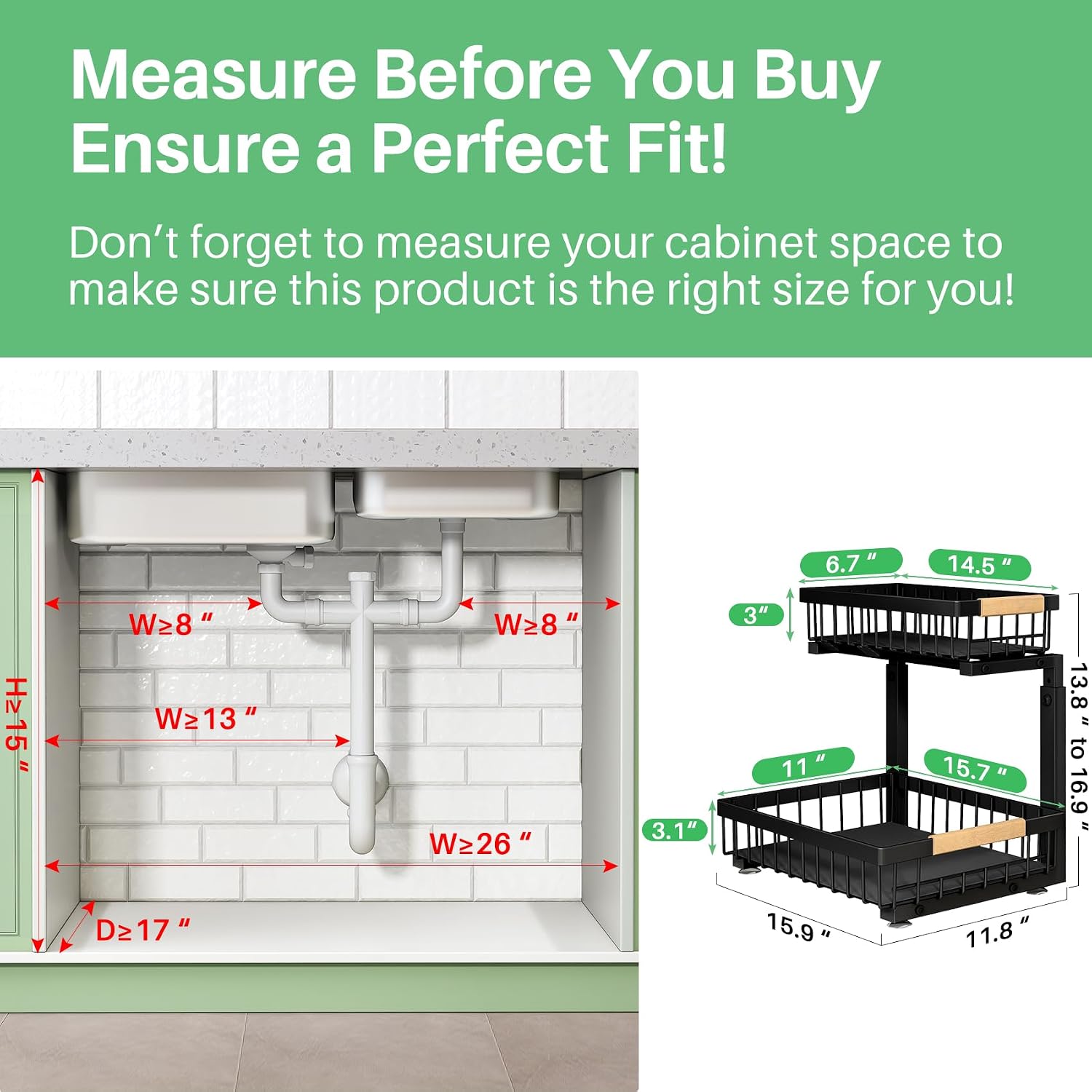
What the specs say: The PXRACK’s leg posts adjust across multiple positions, giving you a meaningful range of platform heights above the cabinet floor. That matters because disposal units vary significantly in body length — a compact InSinkErator Badger 5 hangs shorter than a high-torque Evolution Excel. Before ordering any adjustable organizer, measure the lowest point of your disposal (including the bottom of the motor housing) above the cabinet floor. That number is your minimum platform clearance requirement.
The honest tradeoff: Raising the shelf platform to clear the disposal reduces the headroom above the shelf. If you’re storing tall bottles of dish soap or 32-oz spray cleaners, verify that the cabinet’s interior height minus your required disposal clearance leaves enough room above the shelf. The math isn’t always favorable.
Family Handyman’s coverage of under-sink storage solutions notes that adjustable-leg organizers are consistently the most flexible option for plumbing-complicated cabinets — but emphasizes that “flexible” still requires measuring before buying.
Pull-Out Organizers: Real Usable Depth vs. Marketing Depth
Pull-out organizers — essentially shallow drawers on full-extension slides (slides that allow the drawer to extend completely out of the cabinet, so you can see and reach everything inside) — have earned genuinely passionate reviews from owners with mobility limitations. Across aggregated reviews on Houzz, the pattern is consistent: owners who struggle with bending and squatting describe full-extension pull-outs as transformative, not just convenient. When your supplies come to you rather than requiring you to crouch and reach, daily use changes meaningfully.
But there’s a specification gap worth naming explicitly: advertised depth versus usable depth.
The Seinloes expandable under-sink organizer illustrates this honestly. A four-star owner review — candid enough to be worth quoting — notes that in a standard 24-inch base cabinet, the actual usable depth gain from the pull-out is 11–12 inches, not the full 24 inches the cabinet nominally provides. The front-to-back travel of the slide, plus the space the mounting bracket occupies at the rear, eats the difference. That’s not a defect; it’s how slide geometry works. But if you’re planning to store long-handled scrub brushes or full-size dish soap bottles lying flat, 11–12 inches of forward travel may feel limiting.
The same reviewer flags a second real limitation: the width doesn’t lock at a chosen expansion point without additional fastening. The Seinloes is expandable (it telescopes sideways to fit cabinets of different widths), but the expansion joint can migrate over time without a screw or secondary fastener holding it in position. This is a known, fixable issue — a single self-tapping screw through the expansion overlap solves it — but it’s the kind of thing that’s frustrating to discover after installation if you weren’t expecting it.
By the Numbers
| Organizer type | Typical usable depth (24” cabinet) | Disposal clearance method | Best for |
|---|---|---|---|
| Adjustable-height riser | Full cabinet depth (static shelf) | Leg height adjustment | Disposal clearance + vertical storage |
| Full-extension pull-out | 11–14 inches of forward travel | Positioned beside disposal | Mobility-limited users, daily-access items |
| U-shaped fixed shelf | Full width, notched center | Pre-notched cutout | Predictable plumbing layouts |
Adhesive vs. Screw Installation: When Tape Is Enough and When It Isn’t
The Kitstorack under-sink organizer has built a following largely on the strength of its 3M adhesive tape installation. Owners reviewing it are frequently surprised — “shocked” is a word that appears more than once in aggregated reviews — at how much usable space remained after loading all their cleaning supplies back in. The 3M tape holds reliably for typical cleaning supply loads: spray bottles, dish soap, sponge caddies, and similar items.
But across all pull-out and wall-mounted organizer reviews, a clear pattern emerges when the load gets heavier: adhesive-only installation is not sufficient for cast iron, heavy pots, or dense items like full gallon jugs. Owners who installed for heavier loads and skipped the screws consistently report eventual adhesive failure — usually not catastrophic, but a gradual peel that ends with the organizer shifting or dropping.
The practical decision rule here is straightforward:
- Cleaning supplies, spray bottles, sponges, light pantry overflow → 3M adhesive is well-documented to hold; the Kitstorack approach works
- Heavy bottles (full gallon jugs, cast iron, pots) → screw installation is the correct answer, and most organizers include mounting holes for exactly this reason
Apartment Therapy’s coverage of under-sink organizer options notes that 3M VHB-class tape performs reliably on smooth cabinet interiors but can fail on textured melamine or particleboard edge surfaces — worth checking your cabinet interior finish before committing to adhesive-only installation.
Cabinet Type Matters: Face-Frame vs. Frameless (IKEA SEKTION)
If your kitchen uses IKEA SEKTION cabinets — or any European-style frameless cabinet (a box without an interior face frame, meaning the cabinet opening is the full interior width) — most under-sink organizers will fit with fewer complications than in traditional American face-frame cabinets. Here’s why:
A face-frame cabinet (common in Hampton Bay, KraftMaid, and most builder-grade stock lines) has a wood border on the front of the cabinet box that reduces the usable opening width by 1–2 inches per side. Expandable pull-outs and fixed organizers need to account for this narrowing.
A frameless cabinet (IKEA SEKTION, most European brands) offers the full interior box width at the opening, which is typically 1–3 inches wider than the nominal face-frame equivalent. This makes fitting organizers easier, but also means tension-fit or friction-fit organizers may need to span a wider gap than the product’s expansion range covers.
Before ordering: measure the interior width at the opening (the narrowest point), not the cabinet face width. This is the measurement that determines whether an expandable organizer will reach.
This Old House’s guidance on kitchen cabinet organization reinforces that interior-opening measurement is the single most common source of organizer return and fit error — more so than depth or height.
Frequently Asked Questions
Will an adjustable-height under-sink organizer clear my garbage disposal and drain pipes?
It depends on the disposal’s body length and the organizer’s leg-height range. Measure the lowest point of your disposal above the cabinet floor before ordering. Owners of the PXRACK consistently report successful clearance adjustments, but the math has to work for your specific disposal model.
How much usable depth do pull-out organizers actually add in a standard 24-inch base cabinet?
Based on owner-reported measurements across multiple models, expect 11–14 inches of usable forward travel — not 24 inches. Slide geometry and rear mounting brackets consume the difference. Plan your storage around what actually pulls forward, not the cabinet’s nominal depth.
Is the adhesive installation strong enough for cleaning supplies and heavier bottles?
For standard cleaning supplies and spray bottles, 3M adhesive performs well in long-run owner reviews. For heavy items — full gallon jugs, cast iron, dense bottles — screw installation is consistently recommended. Most organizers include screw-mount holes for this reason.
Can these organizers fit in a frameless IKEA-style cabinet as well as a face-frame cabinet?
Yes, but the fit math differs. Frameless cabinets offer a wider opening at the full interior width; face-frame cabinets reduce the usable opening by 1–2 inches per side. Measure the interior opening width (the narrowest point) for either cabinet type before selecting an expandable organizer.
Do I need to drill to install these, or will the included tape and suction cups hold long-term?
For light loads, 3M adhesive tape (used in the Kitstorack and similar products) holds reliably on smooth cabinet surfaces. Suction-cup-only attachment is not a long-term solution for anything heavier than a small caddy. If you’re storing items heavier than approximately 10–15 lbs total, drilling for screw installation is the safer choice.
The Decision Rule
Here’s the honest summary after reading the specs and owner reviews across these product categories:
- If your disposal hangs low and blocks the center of the cabinet → start with an adjustable-height riser like the PXRACK, confirm leg range covers your disposal body length, and measure headroom above the shelf before committing.
- If mobility or daily access is your primary concern → a full-extension pull-out is worth the 11–12 inch depth tradeoff; the ergonomic payoff in owner reviews is consistent and real.
- If you want adhesive-only installation → the Kitstorack’s 3M tape approach is well-documented for standard cleaning supply loads; skip it if you’re storing anything heavy.
- If you have an expandable organizer like the Seinloes → plan to add a screw through the expansion joint, and calibrate expectations on usable depth rather than cabinet nominal depth.
The under-sink cabinet is the one storage problem that punishes guessing. Measure the disposal clearance, the interior opening width, and the headroom above your intended shelf — in that order — and the right product category becomes obvious before you spend a dollar.